
by Anthony Fallone
edited by Collin Colsher
This is a work in progress, so there will surely be updates to come. What follows is a mythos timeline of the early history of Gotham City in the Modern Age. (i.e. everything prior to the birth of Bruce Wayne in 1963). Notably, some RPG source books have been used as references. If you have any suggestions/additions, drop me (Anthony Fallone) a line in the comments.
—Circa 50,000 BCE. REFERENCE from Batman: The Return of Bruce Wayne #1. Cro-Magnon groups, such as The Bear Tribe and Wolf Tribe, are active on the Eastern North American coast, including at the future site of Gotham. The immortal Vandar Ang takes leadership of the Wolf Tribe, which will eventually come to be known as the Blood Tribe (aka Blood Mob) under his leadership.
—Circa 38,000 BCE. REFERENCE from Shadowpact #5. When an unnamed evil immortal warlock is nearly killed, his assistant puts him in a state of magickal hibernation and buries him in a hidden underground tomb at the exact future site of Gotham. (This item is said to occur forty millennia before the 21st century.) The sleeping demonic presence of the warlock (who will later take the name “Doctor Gotham”) will influence a thousand generations of area residents to come, acting as a secret catalyst for strangeness and evil at this location.
—Circa 38,000 BCE. REFERENCE from Final Crisis Director’s Cut #1, Final Crisis #6-7, Batman: The Return of Bruce Wayne #1, and Batman: The Return of Bruce Wayne #3. Following the demise of the Bear Tribe (and the death of its last living member, Anthro), a war erupts between the Deer People aka Deer Tribe and the current incarnation of Vandar Ang’s Blood Mob aka Blood Tribe. The interference of a time-traveling 21st century Batman (Bruce Wayne) leads to victory for the Deer People. (Vandar Ang leaves the Blood Tribe and will later take the name Vandal Savage.) Influenced by Batman, bats become a central part of the Deer People’s mythology. Eventually, the Deer People will fracture into divided sub groups, but a central group will change its name to the Miagani, meaning Bat People.
–Early 1600s. REFERENCE from Batman: The Return of Bruce Wayne #3. Jon Valor aka the Black Pirate becomes the scourge of the local waterways.
–1609. REFERENCE from Batman: The Cult #1, The Daily Planet Guide to Gotham City, & Batman: The Return of Bruce Wayne. The three islands off the east coast of North America that make up modern day Gotham are now primarily inhabited by the Native American Miagani tribe (formerly known as the Deer People). A group of pilgrims/pioneers attempt to colonize the region but disappear quickly, leaving only a pool of blood to be discovered by members of another colony. With the arrival of more and more pilgrims into the area, the last of the divided Deer People move deeper into the local woods and caves, joining the Bat People (who are now also referred to as the Ghost People, due in part to their elusiveness).
–1635. REFERENCE from The Atlas of the DC Universe & The Daily Planet Guide to Gotham City. Swedish (sometimes claimed to be Norwegian) mercenary-sailor Captain Jon Logerquist establishes the settlement that will later become Gotham. Accounts of its founding differ by source. Dutch records state that Logerquist founded a settlement on the South Island named Nieuw Rotterdam, which was incorporated into the colony of New Netherland. Swedish accounts, by contrast, claim the settlement was christened Fort Adolphus in honor of the famed Swedish general Gustavus Adolphus. These versions are reconciled by the prevailing view that the settlement was first established under Swedish control as Fort Adolphus, before later passing into Dutch hands and being reconstituted as Nieuw Rotterdam (aka New Rotterdam).
–1630s. The Wayne Family comes to colonial America from Scotland and settles in New Rotterdam, know also known as Gotham, Gothame, Gotham Village, Gothame Village, Gotham Town, Gothame Town, Gotham Colony, or Gothame Colony. Most of Waynes become merchants, and they found a merchant house.
–1640. REFERENCE From Batman: The Return of Bruce Wayne #2. In New Rotterdam/Gotham/Gothame, Martin Van Derm is the “keeper of the register of Gotham Colony.” He is also a painter.
–1640. FLASHBACK from Batman: The Return of Bruce Wayne #2. Nathaniel Wayne is a witchfinder in New Rotterdam/Gotham/Gothame who goes by the alias Brother Malleus, most likely a reference to the book Malleus Maleficarum (1486).
–1650s. REFERENCE from Batman: The Return of Bruce Wayne #5—originally told in Detective Comics #205. Colonial frontiersman Jeremy Coe uses a section of what will become the modern day Batcave as his hideout.
–Mid 17th century. REFERENCE from The Return of Bruce Wayne #4. A Van Derm couples with a person of the Miagani tribe, not only creating a link between the Miagani and the Van Derms, but also giving the Van Derms access to the secrets of the Miagani.
–Mid 17th century. FLASHBACK from The Batman Chronicles #6—and REFERENCE from Batman Secret Files and Origins #1 & The Daily Planet Guide to Gotham City. (This entry is variously dated, with some sources placing it in the early-to-mid 17th century and others as late as the early 18th century. Suffice to say, it must go after the slave trade has gotten underway in the Americas.) A recently freed slave of mixed African and European ancestry named Hiram, who has been on his way to the whaling settlement of Blüdhaven, stumbles across the dead body of a murder victim. (Blüdhaven is located in Haven County, mere miles south of Gotham County and separated only by a large waterway.) Hiram does his best to give the dead man a proper burial, but, upon entering Blüdhaven, he is accused of being the murderer by the victim’s brother, a local merchant named Rance Benedict, who is about to be appointed as the town constable. Hiram retreats north to the woods of what is now the civil township of Sommerset on the mainland shores west of the Core Islands. He intends to clear a plot of land for the purpose of building a shanty home or church. En route to the Sommerset woods, Hiram meets a mysterious “doctor” who warns him of a mad killer from London named Epsilah Clevenger. Clevenger is also known by the British authorities as “The Mimic” due to his uncanny ability to impersonate others. The doctor urges Hiram not to build a home or church, but an asylum instead. That night, during a storm, Hiram believes the doctor is being murdered. He then hears Rance Benedict approaching, apparently seeking vengeance. Fearing for his life, Hiram shoots and kills Benedict in what he believes is self-defense. The doctor then reveals himself to be Clevenger, having staged the murder and impersonated Benedict. Whether Benedict truly intended violence is left unresolved. Clevenger uses the killing as blackmail to force Hiram to build an asylum. The site of Hiram’s asylum will become the site of Arkham Asylum many years later.
–1674. REFERENCE from The Atlas of the DC Universe & The Daily Planet Guide to Gotham City. During the English takeover (presumably following the Treaty of Westminster), New Rotterdam is seized by British forces. English General Adam Howe (named Joseph Howe in The Daily Planet Guide to Gotham City) is appointed Governor and officially drops the New Rotterdam name, making the settlement’s only names Gotham or Gotham Village.
–1718. REFERENCE from Batman: The Return of Bruce Wayne #2-3. Jack Valor aka the Black Pirate II (grandson of the original Black Pirate) wars with his rival Commodore Thatch aka Blackbeard aka Vandal Savage along the shores of Bristol Bay. Valor is joined by a time-displaced 21st century Bruce Wayne, who helps him defeat Savage. Valor also communes with the Miagani aka Bat People. Bruce gives Valor instructions. The Black Pirate will have adventures in the area for decades to come. (He’ll eventually retire to Philadelphia.)
–REFERENCE from The Return of Bruce Wayne #6. A Van Derm meets with the Miagani aka Bat People. Together, they create a small box/casket, which can only be opened by a Miagani whistling sound. They put into the casket several items related to 21st century Bruce Wayne’s time-jumps. The Van Derms are tasked with guarding the casket.
–1750. REFERENCE from The Return of Bruce Wayne #3. Jack Valor visits the Van Derms in Gotham, upon which he sees the Bat-casket for the first time and adds his notes into it.
–1765. FLASHBACK from Batman #452 & Batman and Robin #16. In Gotham, Thomas Wayne (who will later go by the name Simon Hurt) and his five companions, including Jacob Stockman, perform an occult ritual by trying to sacrifice a woman to summon Barbatos. When it goes wrong, everyone except Wayne flees.
–1776. REFERENCE from The Daily Planet Guide to Gotham City. By the time of the Declaration of Independence, Gotham is occupied by British and Hessian forces. Great Britain hopes to continue holding Gotham in order to keep patriot forces to the north and south of the city from maintaining reliable communications and supply lines.
–1779. REFERENCE from The Atlas of the DC Universe, Detective Comics #653, Batman and Robin #10, & Batman: The Return of Bruce Wayne #4. During the American Revolution, Darius Wayne, his brother, real-life historical figure “Mad” Anthony Wayne, and Transbelvian-born General Jarsc Volzcek fight against the British and Hessian forces. The British have held Gotham for much of the war, but, with the help of Darius, a victory is secured for the Americans as Volzcek’s forces retake the city on November 21, 1779. Darius is immortalized in a portrait depicting him defiantly setting ablaze British ships during this battle. Volzcek will also be forever hailed as a hero in Gotham.
–Late 1770s to early 1780s. REFERENCE from Gotham Underground #9. On the opposing side of the American Revolutionary War, Sir Nigel Cobblepot fights against Gotham before eventually calling the city his home.
–REFERENCE from The Daily Planet Guide to Gotham City. By this point, Gotham has expanded to cover the lower half of South Gotham Island. The remainder of the island, along with the two neighboring islands and the mainland to the north and west, collectively make up what is known as Gotham County. Shortly thereafter, Gotham is incorporated as a city. This is the first instance of the use of the name Gotham City.
–1790. REFERENCE From Batman: Legends of the Dark Knight #6-10 (“Gothic”) and The Daily Planet Guide to Gotham City. Construction begins on Gotham Cathedral—which will eventually be 150 feet tall. The cathedral is built along the border of Old Gotham (the original Gotham Village) and South Gotham Island. The area around the cathedral becomes known as Cathedral Square. The Daily Planet Guide to Gotham City contradicts “Gothic” by saying that the Gotham Cathedral was built in 1810. We can take this to mean that the Gotham Cathedral starts construction now but won’t be topped-out until 1810.
–1795. REFERENCE from The Atlas of the DC Universe, The Daily Planet Guide to Gotham City, and Batman and Robin #12. A large plot of land is rewarded to Darius Wayne in Bristol Township’s Crest Hill district on the mainland shores north of the Gotham Islands (or south of the Gotham Islands according to The Atlas of the DC Universe) for his heroic efforts during the war. Architect Nathan Van Derm begins construction on Wayne Manor. During the construction of the manor, an accident takes the life of Darius. Construction ceases and the unfinished manor falls into the possession of the Van Derm family.
–Early 19th century. REFERENCE from Batman: Gates of Gotham #2. The patriarch of the Elliot family founds the Gotham Herald. The Elliots will make a fortune in the media/news business for a century to follow.
–1825. REFERENCE from The Daily Planet Guide to Gotham City. By this point, Gotham City’s borders have now expanded upward to include some three-quarters of South Gotham Island, including the annexation of the village of Neville.
–Mid 1840s. REFERENCE from The Daily Planet Guide to Gotham City. By this point, Gotham City’s borders have now expanded upward to include all of South Gotham Island as well as the western third of Center Gotham Island, creating its Chelsea and Burnley Harbor districts, which by this point has become the permanent home of Gotham University.
–Mid 1840s. REFERENCE from Batman: The Return of Bruce Wayne #5—originally referenced in The Brave and The Bold #89. The date is pure conjecture, but this item is said to have occurred about 150 years prior to the events of The Brave and The Bold #89. The fanatical religious cultists known as the Hellerites become active in Gotham City. Immediately feared and hated by most of Gotham City’s residents, the Hellerites meet a tragic end as their settlement is burned to the ground by an angry mob. The entire sect is killed.
–REFERENCE from Batman Secret Files and Origins #1 and The Daily Planet Guide to Gotham City. Financier Charles Arwin Wayne comes to Gotham City from Boston with his two sons Solomon Zebediah Wayne and Joshua Thomas Wayne. (Solomon’s original middle name had the initial E, but it was later retconned to Zebediah.) Charles manages the Wayne family’s modest fortune by buying cheap property, including swampland. Shortly after their arrival, Charles dies from tuberculosis at the age of 52, leaving his fortune to his sons.
–REFERENCE from the second feature to Batman: Legends of the Dark Knight #27 (“Handcarts and Hellholes: A Brief History of Gotham City”). Solomon Wayne returns to Gotham City (specifically to Old Gotham, formerly Gotham Village) from Boston, having earned a Harvard degree and an appointment to a judgeship. He gained his federal judgeship through the influence of his classmate’s father, Senator Nugent Bolle. Judge Solomon Wayne also becomes an entrepreneur in Gotham City, starting a dozen businesses, including the Gotham Buggy Whip Works. Over the course of six years, he becomes one of Gotham City’s most prosperous citizens. Solomon’s brother Joshua, though overshadowed by Solomon, jointly maintains the nearly dozen Wayne businesses.
–1855. REFERENCE from Batman: Shadow of the Bat #45. Magnate Jerome K Van Derm finishes construction on the ten-bedroom Wayne Manor just outside of Gotham, adding a railroad line through the property as well. However, when Van Derm’s company goes under, Van Derm commits suicide, leaving the property vacant and in the hands of a realty agency.
–July 4, 1858. REFERENCE from Batman: Shadow of the Bat #45. Judge Solomon Wayne and his brother Joshua Wayne purchase Wayne Manor, bringing the property back into the family. According to an entry in Solomon’s diary, he likes that the estate is outside of Gotham but close enough that he can stay in touch with his property interests in the city. However, the main reason the Wayne brothers purchase the manor from the realtor is because they discover a swarm of bats coming from a subterranean tunnel underneath the manor grounds. Being abolitionists, the brothers decide purchasing the manor will be good for their cause as they can help lead escaped slaves from the south up through the east coast to freedom in Canada through the underground tunnels.
–Late 1850s. FLASHBACK from Legends of the Dark Knight #27—and referenced in the second feature to Batman: Legends of the Dark Knight #27 (“Handcarts and Hellholes: A Brief History of Gotham City”) and Batman: Gates of Gotham #2. (Note that both Batman: LOTDK #27 and The Daily Planet Guide to Gotham City place this item in June 1865, but, thanks to retcons from Batman: Gates of Gotham, it must go earlier. Batman: Gates of Gotham #2 specifically places this item in 1840, but, if we push it as late as it can possibly go—in an effort to honor LOTDK #27, then the late 1850s it is. Interestingly, the second feature to Legends of the Dark Knight #27 tells us that Cyrus Pinkney will die at the young age of forty, which points toward this item occurring in the late 1850s anyway! So maybe Gates of Gotham wasn’t so much as a retcon of LOTDK #27, but instead a confirmation of its contradictory back-matter.) Judge Solomon Wayne declares a man guilty and sentences him to thirty days in the county jail for assaulting a man named Cyrus Pinkney. The man tries to attack Solomon, who then beats him in the head with a law book and the Bible. After the constables send the man away to jail, Solomon talks with Pinkney, finding out he is an architect. Interested in seeing samples of Pinkney’s work, Pinkney shows Solomon sketches of gothic architectural designs. Solomon writes a letter to his wife-to-be (presumably second wife Dorothea) about this interaction.
–Late 1850s. FLASHBACK from Legends of the Dark Knight #27—and referenced in the second feature to Batman: Legends of the Dark Knight #27 (“Handcarts and Hellholes: A Brief History of Gotham City”) and Batman: Gates of Gotham #2. (Note that both Batman: LOTDK #27 and The Daily Planet Guide to Gotham City place this item on December 12, 1865, but, thanks to retcons from Batman: Gates of Gotham, it must go earlier. Batman: Gates of Gotham #2 specifically places this item in 1840, but, if we push it as late as it can possibly go—in an effort to honor LOTDK #27, then the late 1850s it is. As stated above, the second feature to Legends of the Dark Knight #27 tells us that Cyrus Pinkney will die at the young age of forty, which points toward this item occurring in the late 1850s anyway!) Six months after meeting with Cyrus Pinkney, Solomon Wayne gives a speech to the Gotham Property Holders Association, promoting Cyrus Pinkney’s vision for Gotham City’s architecture, much to the chagrin of certain critics.
–Late 1850s. REFERENCE from Batman Secret Files and Origins #1. Solomon Wayne (age 77) and his second wife, Dorothea (age 37), have a child named Alan Wayne (full name Alan Kingston Wayne).
–Early 1860s. REFERENCE from The Daily Planet Guide to Gotham City. Wayne Shipping provides oceanic transport in addition to transcontinental railway shipping.
–1860. FLASHBACK from Batman: Gates of Gotham #2. Nicholas Anders, his stepbrother Bradley Gate, and his father arrive in Gotham City.
–November 4, 1860. FLASHBACK from Batman: Shadow of the Bat #45. Charles Lindon, a friend of Solomon Wayne, brings a group of escaped slaves to Wayne Manor, but on their trail are bounty hunters. Joshua has gone back to find one of the slaves, Sam Barley, who wanted to return to Maryland, and fights off the bounty hunters before bringing Sam to the caves beneath Wayne Manor. Solomon, whose wife is pregnant, and Joshua go out in a snowstorm to cover their tracks, and when they run into the bounty hunters, Joshua promises to draw them away. Solomon never sees him again. Joshua leads the bounty hunters onto a rope bridge, where one stabs him, and he brings down the bridge, killing them all. Joshua knows he is dying, and he knows he can’t let his body be found, as it will damage the reputation of the Wayne family, so he crawls into the drainage outlet (what will later become the Wayne Manor wine cellar) to die.
–November 9, 1860. REFERENCE from Batman: Shadow of the Bat #45. A Gotham Gazette article from 1860 shows that the Maryland bounty hunters’ bodies were found in the Gotham River.
–1861-1865. REFERENCE from Gotham Underground #9. During the American Civil War, Union Army Colonel Nathan Cobblepot rises to hero status after defending Gotham in the Battle of Gotham Heights.
–1860s. REFERENCE from Detective Comics #843-844 (and gleaned from several other titles). The original Cosa Nostra crime organization in Gotham City is the Sabatino Mob, which now comes to America from Sicily. Over the course of the next decade, other Sicilian mafia groups will quickly emigrate to Gotham City as well.
–REFERENCE from from the second feature to Batman: Legends of the Dark Knight #27 (“Handcarts and Hellholes: A Brief History of Gotham City”). It is mentioned that Cyrus Pinkney dies on the eve of his fortieth birthday.
–REFERENCE from from the second feature toBatman: Legends of the Dark Knight #27 (“Handcarts and Hellholes: A Brief History of Gotham City”). Judge Solomon Wayne dies at the age of 104.
–1870s. FLASHBACK from Batman: The Return of Bruce Wayne #3-4. Alan Wayne has become depressed and is intending to commit suicide by jumping into the river. However, on this same night, he is passed by a melee (involving Vandal Savage, Jonah Hex, Thomas Wayne aka the future Simon Hurt, and others). Alan rushes into the fray, saving the life of a woman named Catherine “Katie” Van Derm. Not long after, the two get married and move back into Wayne Manor. Tragically, Catherine dies while giving birth to her and Alan’s son, Kenneth Wayne.
–1870s. REFERENCE from Batman #568. The Gotham Botanical Gardens are established courtesy of a grant from C.L. Wayne (possibly made in the name of Catherine Wayne).
–REFERENCE from Batman Secret Files and Origins #1. Alan Wayne spearheads the development of the Gotham Railworks and the building of Robinson Central Terminal. Using the power of the locomotive, Wayne Shipping, which carries scores of European goods to the developing American interior, fosters the growth of the Wayne Corporation (WayneCorp) aka Wayne Enterprises. Alan names his son Kenneth as sole heir to the Wayne fortune and businesses.
–REFERENCE from Batman/Huntress: Cry for Blood #1 and Detective Comics #843-844 (and gleaned from several other titles). The Sabatinos begin to lose their mob influence in Gotham City due to the emergence of the “Five Families” structure.
–1877. FLASHBACK from Batman: Gates of Gotham #2. Architect Nicholas Anders and his stepbrother Bradley Gate are approached by Alan Wayne, who wants the two men to construct a large suspension bridge that will provide access to the Center Gotham Island from the west. Alan has been wanting to expand his family business, which includes the railroad, since 1871.
–REFERENCE from Gotham Underground #9. Having gained his fortune in the steel industry, Theodore Cobblepot is on his way to becoming Gotham City’s longest running mayor. Unfortunately, the Cobblepot family fortune will later be squandered away by his son and then grandson on an unsuccessful hotel.
–1881. FLASHBACK from Batman: Gates of Gotham #1. By this point, Wayne Railroad & Transportation Company exists. Alan Wayne introduces Nicholas Anders to newspaper tycoon Edward Elliot and Mayor Theodore Cobblepot. Upon completion of the New Trigate Bridge, Nicholas and his stepbrother Bradley are commissioned by the city to build two additional bridges, one connecting to the North Gotham Island and one connecting to the South Gotham Island.
–1880s. REFERENCE from Detective Comics #629 and The Daily Planet Guide to Gotham City. Blackgate Prison starts and finishes construction on Blackgate Isle, a small island in Gotham Bay.
–FLASHBACK from Batman: Gates of Gotham #2-3. Nicholas Anders and Bradley Gate have a meeting with the founding families. Six months after this meeting, the first Wayne Tower begins construction. Shortly after the construction of Wayne Tower completes, Nicholas takes his stepbrother’s surname, Gate, the two becoming known as “The Gates of Gotham.” Within a few months, Nicholas also gets married and has a daughter.
–FLASHBACK from Batman: Gates of Gotham #3. Nicholas Anders finishes construction on Theodore Cobblepot’s new club, the Iceberg Lounge. Alan Wayne proposes that Nicholas and his stepbrother build a retaining wall along the eastern shoreline of Gotham City to provide additional land and a foundation for an even bigger bridge that will connect the main city to one of the outer counties.
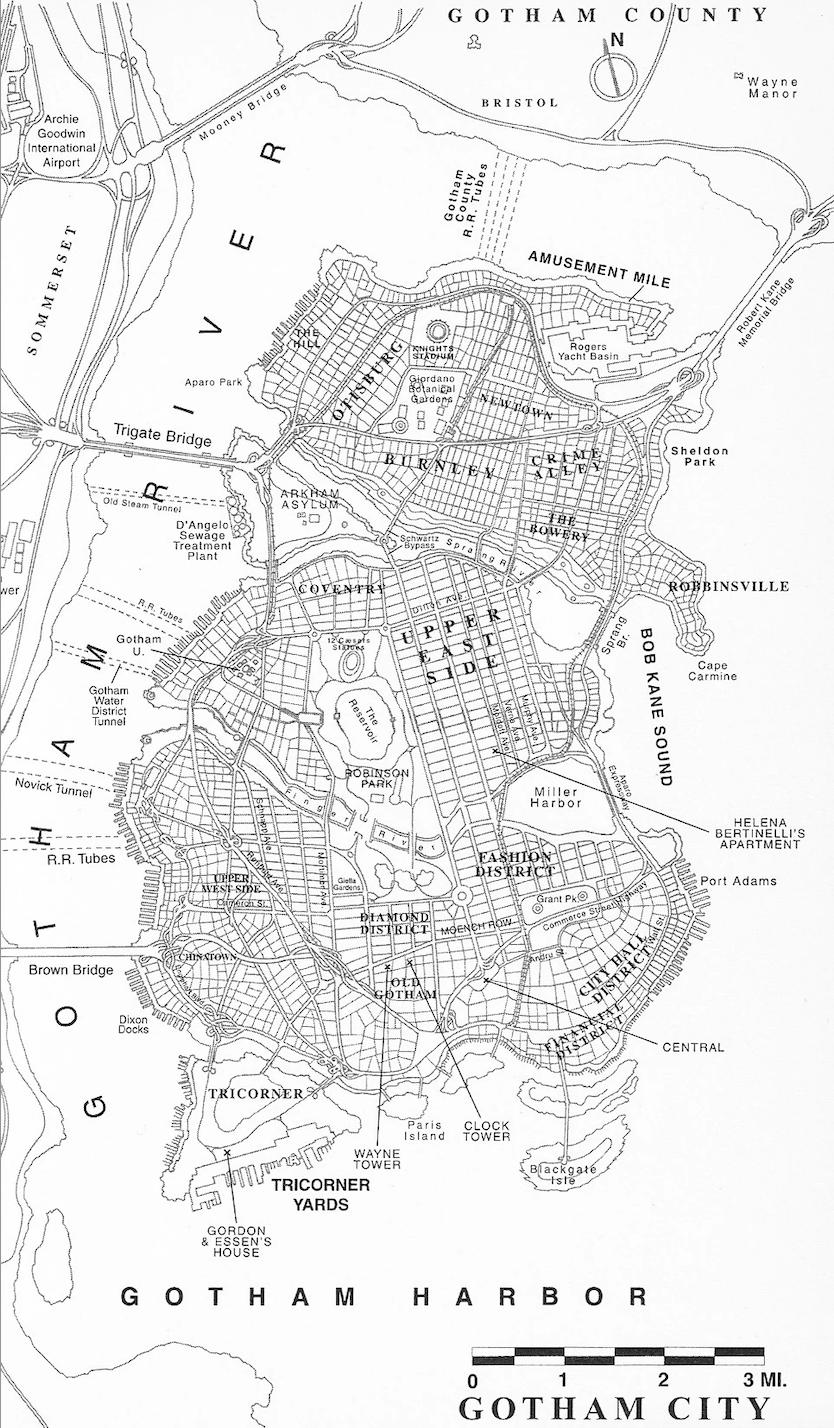
–Summer 1892. FLASHBACK from Batman: Gates of Gotham #3. Nicholas meets with the founding families, including Cameron Kane. Kane is helping finance the new bridge with the assurance that it will connect to Kane County—the land just north of Gotham City. However, the group is split between Kane County and the large plot of land owned by Alan Wayne. The decision is left to Nicholas, who decides to connect the bridge to Wayne’s land. Notably, in Gates of Gotham #3, Wayne’s land is said to be east of Gotham City. However, according to the most-commonly referenced Modern Age map of Gotham City (originally created by Elliot R Brown in 1998), there is no major land mass directly east of Gotham City, as the city is adjacent to Great Bay, just north of Brigantine and Atlantic City, NJ. As such, there is only water directly east of Gotham. Additionally, in the Brown map, the mainland north of Gotham is Kane County, meaning Bristol Township (the home to Wayne Manor) is within Kane County. Now, it could either be the case that Kane County was later annexed or absorbed by Gotham County (most sources say that Bristol Township is within Gotham County) or that “Kane County” was just an informal name for the mainland north of the city but still within Gotham County, as most of the property there is owned by the Kane family. In either case, Gotham City is the county seat and largest city within the county.
–1892-1893. FLASHBACK from Batman: Gates of Gotham #3. Bradley and Nicholas work on constructing the colossal bridge for several months, but they are ultimately met with disaster. Bradley is working on the bridge’s foundation below the water line with his underwater protection suit when the bridge suddenly comes crashing down on him. Nicholas only finds Bradley’s helmet among the wreckage.
–1893. FLASHBACK from Batman: Gates of Gotham #4. A funeral is held for Bradley Gate. Alan Wayne, Edward Elliot, Theodore Cobblepot, and Cameron Kane are in attendance. Nicholas is blamed for the accident that caused his stepbrother’s demise, and the bridge is adjusted to lead to Kane County instead. Nicholas spends the next month searching the wreckage in his underwater protection suit to find proof that Cameron Kane sabotaged the bridge. Desperate, Nicholas approaches Alan Wayne at his home, claiming Kane caused the disaster to raise the value of his land as Gotham City’s new gateway. Alan tells Nicholas that he and the other founding family heads won’t help him investigate Kane, as they intend to keep this a secret, as “secrets are influence.”
–FLASHBACK from Batman: Gates of Gotham #4. Nicholas Gate, wearing his underwater protection suit, breaks into the Bristol Township home of Cameron Kane and is shot at by Cameron’s son, Robert Kane. Angered, Nicholas strangles Robert to death. Police arrive and take Nicholas away.
–FLASHBACK from Batman: Gates of Gotham #5. Alan Wayne delivers a journal to Nicholas Gate, who has been committed to Arkham Asylum, saying it will help with his recovery. Outside the asylum, Alan asks Cameron Kane if he had anything to do with sabotaging the bridge and killing Bradley Gate. Kane denies any involvement. (It’s worth noting that this item is explicitly dated as 1889; however, that date is a continuity error that conflicts with other items in the very same story. For example, Nicholas’s killing of Robert Kane—the reason for his incarceration—could not have occurred any earlier than 1892)
–1895. REFERENCE from Batman: Shadow of the Bat #39 and The Daily Planet Guide to Gotham City. (The Daily Planet Guide to Gotham City gives the incorrect date of 1894.) After having an affair with a sex worker, unscrupulous banker Cyrus Gold refuses to yield to blackmail when she tries to extort him for money after becoming pregnant with his child. This leads to her pimp bludgeoning Gold with a shovel, stealing a hundred dollars from him, and tossing his body into Slaughter Swamp. As he drowns, he curses them.
–1899. REFERENCE from The Daily Planet Guide to Gotham City. Twelve-year-old Giuseppe Bertinelli arrives in Gotham City via the Dixon Docks. His family has come from Ciminna, Sicily.
–REFERENCE from Batman Secret Files and Origins #1. Alan Wayne and Kenneth Wayne form Wayne Chemical aka Wayne Chemicals. Shortly thereafter, Alan dies at the age of sixty-three, making Kenneth the new owner/head of Wayne Enterprises. Under the guidance of Kenneth, Wayne Chemical grows. Kenneth also forms Wayne Manufacturing. However, Kenneth dies at a relatively young age from alcohol poisoning, leaving the Wayne fortune to his wife Laura Elizabeth Wayne, age 37 at the time of her husband’s death. Their son, Patrick “Jack” Morgan Wayne (named Patrick Alan Morgan Wayne according to The Daily Planet Guide to Gotham City), is only an infant at the time of Kenneth’s death. Laura, in addition to managing the company, becomes a staunch prohibitionist, pushing for legislation to enact the alcohol ban. Patrick also has a brother named Silas. (Although not much is known about them, Benjamin and Abigail Wayne may be contemporaries of this generation of Waynes. Their gravestones are depicted in Batman: Shadow of the Bat #45).
–1900. REFERENCE from The Daily Planet Guide to Gotham City. The Gotham Expo begins the century by unveiling an experimental underground railway tunnel connecting South Gotham Island with the mainland near Blüdhaven. Like the rest of the Gotham Expo, the subway experiment is decorated in an “Alice in Wonderland” theme and will continue to operate until 1920, when its parent company, the Greater Gotham Underground Railway, will collapse in a stock bubble scam.
–1918. REFERENCE from The Daily Planet Guide to Gotham City. Just after World War I, Gotham City begins its process of annexing Glendale, Manchester-Lyntown, and Burnley-Bryanttown—three sister cities scattered across the Core Islands.
–REFERENCE from Batman: Legends of the Dark Knight #115. Patrick Wayne has a daughter named Agatha Wayne.
–REFERENCE from Batman: Legends of the Dark Knight #133. Patrick Wayne has a son named Thomas Wayne.
–1920. REFERENCE from The Daily Planet Guide to Gotham City. The Greater Gotham Underground Railway goes out of business due to its involvement in a stock bubble scam. As such, the main train transit route between Gotham City and Blüdhaven—which has been in constant operation for the past two decades—is shut down.
–1920. FLASHBACK from Arkham Asylum: A Serious House on Serious Earth. Amadeus Arkham has been caring for his mentally ill mother, Elizabeth, who has visions of a giant bat-like entity. One day, Amadeus takes a pearl-handled straight razor and cuts his mother’s throat with it to end her suffering. He then blocks out the memory and her death is attributed to suicide.
—Spring 1920. FLASHBACK from Arkham Asylum: A Serious House on Serious Earth. Amadeus Arkham returns to his old home in Gotham City shortly after his mother’s funeral. The next day, he returns to his family in Metropolis. Amadeus works at the State Psychiatric Hospital there. Not long after, Amadeus begins having the mansion he inherited in Gotham City remodeled into a psychiatric hospital, hoping to help the criminally insane.
—1920. FLASHBACK from Batman/Huntress: Cry for Blood #1—and referenced in The Daily Planet Guide to Gotham City. The Bertinellis hold a firm leadership grip over Gotham City’s Italian-American mafia. (The Bertinellis will be the top family for decades to come.) The Five Families consist of the Bertinellis (the number one family), Berrettis (also spelled Beretti), Cassamentos, Galantes, and Inzerillos. Prohibition is enacted, and Giuseppe Bertinelli, head of the Bertinelli Family, recruits the Berettis and Galantes to flood the streets with alcohol. At the same time, the Cassamentos and the Inzerillos are trying to do the same thing, which leads to war. The war between the Bertinelli-Beretti-Galante alliance and the Cassamento-Inzerillo alliance will continue until the end of Prohibition, and it will take the lives of three of Giuseppe’s sons.
–April 1, 1921. FLASHBACK from Arkham Asylum: A Serious House on Serious Earth. Amadeus Arkham returns home to find his wife, Constance, and daughter, Harriet, raped and murdered by Martin “Mad Dog” Hawkins.
–November 1921. FLASHBACK from Arkham Asylum: A Serious House on Serious Earth. The Elizabeth Arkham Asylum for the Criminally Insane opens its doors. (It should be noted that this item is contradicted by a scene in Batman: Gates of Gotham #5 which depicts Arkham Asylum as already existing in 1889.)
–April 1, 1922. FLASHBACK from Arkham Asylum: A Serious House on Serious Earth. On the one year anniversary of his family’s murder, Amadeus Arkham kills “Mad Dog” Hawkins by overdosing him on electroshock therapy. The death is ruled as an accident.
–Mid 1920s. FLASHBACK from Batman: Legends of the Dark Knight #133. With his mother Laura stepping back a bit in her old age, Patrick Wayne shares responsibilities as a co-head of Wayne Enterprises, heading up various construction projects all over Gotham. Soon after, Patrick meets a rough-and-tumble street kid named Brass. Taking a liking to the spunky kid, Patrick brokers his release from police custody (specifically from Detective Loeb). Patrick employs young Brass to work security at a brand new “slum development” construction site. Brass also meets and gets to know Patrick’s bookish son Thomas. Patrick will come to think of Brass as somewhat of a second son as the years wear on.
–REFERENCE from Batman Annual #13 Part 2. A British man named Pennyworth takes over as the head butler of Wayne Manor. According to the second feature to Detective Comics #806-807, which is on incredibly shaky continuity ground, the Pennyworth name could actually be an alias—with the real family name being Beagle. (The second feature to Detective Comics #806-807 shows Alfred—as “Alfred Beagle”—working with MI5, MI6, and MI7 prior to taking his job as head butler at Wayne Manor. However, the very scene in which Alfred takes the Wayne family job seems to show him introducing himself—as “Alfred Pennyworth”—to the Waynes for the first time. This would contradict prior stories—including Batman Annual #13 Part 2 and Batman Secret Files and Origins #1—that show a long linage of Pennyworths working with the Waynes. As such, the details of the second feature to Detective Comics #806-807 are dubious at best, meaning that it’s entirely possible that “Beagle” is an British Intelligence codename, with Pennyworth being the real family name. Therefore, it’s entirely up to you whether or not Pennyworth or Beagle—or some combination of the two—are canon.)
–1929. REFERENCE from The Daily Planet Guide to Gotham City. The stock market crashes, throwing the United States into the Great Depression. Gotham City’s mayor is Archibald Brewster at this time.
–1929. REFERENCE from Arkham Asylum: A Serious House on Serious Earth. In the wake of the stock market crash, Amadeus Arkham is locked away in his own asylum after trying to kill his stock broker.
–Early 1930s. REFERENCE from Batman Secret Files and Origins #1. Upon his mother Laura’s death, Patrick Wayne inherits the family fortune and expands the Wayne Enterprises portfolio, officially starting the Wayne Corporation (WayneCorp) and founding Wayne Technologies (WayneTech). Batman Secret Files and Origins #1 says that Patrick starts WayneCorp “out of the ashes of the Great Depression,” but, to be specific, this expansion, despite all odds, occurs during the Depression.
–1931. FLASHBACK from Batman: Legends of the Dark Knight #133. Due to the Depression, Wayne Enterprises struggles financially. Despite this, Patrick’s slum development project finishes (thanks in part to the tenacity of Brass). Noticing that a Wayne Enterprises employee named Smitty has been skimming off the top, Brass reports it to Patrick Wayne. Impressed, Patrick’s relationship to Brass continues to grow stronger, sometimes even eclipsing the love he shows for his son Thomas.
–FLASHBACK from Batman: Legends of the Dark Knight #133-134. The placement of this item is tough. Because we see Brass smuggling hooch, it’s been placed here in the 1930s. However, LOTDK #135 is said (by Brass himself) to only occur ten years later, yet it seemingly occurs in the 1950s. We’ll have to assume that Brass’ “ten years ago” line is incorrect. Onto a synopsis! Brass continues to rise in the ranks of Wayne Enterprises, earning an office job alongside Patrick Wayne. Despite having graduated into the office, Brass still handles hands-on security for the company. (Patrick shows Brass a model of Wayne Manor, calling it an unrealized project that he wants to build. Of course, thanks to retcons and other stories, Wayne Manor has already long been built. It was actually finished in the mid 19th century. A such, the reference to an unfinished Wayne Manor here must be ignored or it must be regarded as Patrick wanting to update the property.) Soon afterward, Thomas enrolls in a new private school. Meanwhile, Brass begins conducting illegal deals with various mobsters. After Patrick is hospitalized after getting attacked by vengeful ex-employee Smitty, Brass violently shakes down his boss’ rivals. When Patrick returns to the office, he gets into a heated argument with Brass, who wants ownership of the Wayne Manor property as part of a lucrative (but shady) land development deal he’s made with a local gangster. (Again, any references or images here to Wayne Manor being under construction should either be ignored or be reimagined as renovation.) Patrick calls Brass a crook and severs their relationship, both as co-workers and friends. Brass will have bad blood with the Waynes forever more. Notably, the Waynes will keep tabs on Brass, moving forward, getting detailed reports about his actions.
–Early 1933. FLASHBACK from Batman/Huntress: Cry for Blood #1—and referenced in The Daily Planet Guide to Gotham City. As Prohibition ends, the thirteen-year-long mob war between the Bertinelli-Beretti-Galante alliance and the Cassamento-Inzerillo alliance is finally decided. In the end, the Inzerillos sell out the Cassamentos, and Giuseppe Bertinelli serves as a partial mediator, attempting to foster unity among the factions, yet underlying tensions persist among them. Giuseppe is named capo di tutti capi, which roughly translates to “boss of bosses.” The Five Families of Gotham City’s Italian-American mafia continue to consist of the Bertinellis (still the number one family), Berettis, Cassamentos, Galantes, and Inzerillos. (The Bertinellis will continue to be the top family for decades to come.)
–Late 1930s to 1940. REFERENCE from Batman #611, the second feature to Batman: Gotham Knights #10, and The Batman Files. Alan Scott, formerly of Metropolis and Capitol City, debuts as the superhero Green Lantern, becoming protector of Gotham City. Scott goes on various adventures in Gotham City, gaining semi-immortality in the process. One of Scott’s biggest rivals is Solomon Grundy, the former Cyrus Gold, now an undead super-villain based out of Gotham City’s Slaughter Swamp. Starting in 1940, Scott joins the Justice Society of America and begins fighting in World War II (both as Green Lantern and as a US Army soldier).
–REFERENCE from The Daily Planet Guide to Gotham City and Batman: Legends of the Dark Knight #135. Under Patrick Wayne, Wayne Enterprises commits itself toward ecological responsibility and responsible industrialism. Part of this move is because Brass has caused a negative stigma to become attached to the Wayne business name, and Patrick wants to shed this image. Patrick will spend the next decade trying to be more ethical.
–1941-1945. REFERENCE from Batman Secret Files and Origins #1. Patrick Wayne gets involved in the war effort. Wayne Technologies (WayneTech) aircraft plants in Somerset and shipyards in Neville fuel the American war effort during the Pacific War (1942-1945). Notably, Green Lantern Alan Scott splits time between defending Gotham City and fighting overseas in the war.
–Mid 1940s. REFERENCE from Batman #611, the second feature to Batman: Gotham Knights #10, and The Batman Files. After World War II ends, the JSA moves its headquarters into a Gotham City brownstone. Alan Scott will continue adventuring in Gotham City for years to come.
–REFERENCE from Batman Annual #13 Part 2 and Batman Secret Files and Origins #1. English-born Jarvis Pennyworth moves to Gotham (from the UK), becoming the Wayne family butler, taking over for his father (the previous Wayne butler). (As mentioned above, as per the second feature to Detective Comics #806-807, it’s unclear whether or not Jarvis’ actual family name is Beagle or Pennyworth, but this is entirely up to your personal headcanon.) Jarvis lives on the Wayne Manor property along with his unnamed stage actress wife and son Alfred Thaddeus Crane Pennyworth. Notably, Alfred’s father is never actually named in the Modern Age, but his name was Jarvis in previous continuity, so it likely is still Jarvis in the Modern Age. Also, according to Batman Secret Files and Origins #1, Alfred and his mother do not move to Gotham along with his father. Instead, Alfred and his mom stay in England but will make periodic trips to visit Jarvis. In this scenario, Jarvis will visit Essex to go on summer hunting trips with his son. It’s up to your own headcanon on whether Alfred and his mom are Gotham residents or simply frequent Gotham visitors.
–1948. REFERENCE from Detective Comics #784-786. A string of brutal serial killings occur in Gotham City. The murders go unsolved.
–1949. FLASHBACK from Batman/Huntress: Cry for Blood #1. Giuseppe Bertinelli dies and his only surviving son, Alfredo, takes over the family mob.
–1949. REFERENCE from The Daily Planet Guide to Gotham City. The Mafia’s Gotham Commission is founded. It is designed to mediate disputes between what now numbers six mob families within the greater Gotham City area. The Gotham Commission will, however, be answerable to La Commissione in New York, just as are the other Mafia networks in America.
–1950s. Oswald Chesterfield Cobblepot is born.
–1950s. REFERENCE from Batman #611, the second feature to Batman: Gotham Knights #10, and The Batman Files. The JSA members—including Scott—are forced into retirement thanks to a government blacklist.
–1950s. REFERENCE in Batman: Family. The Rossetti (aka Rosetti) family, a smaller Italian-American criminal outfit, rises to prominence by working for the Bertinellis.
–1950s. REFERENCE from Batman Secret Files and Origins #1. Thomas Wayne goes to college. After graduating, Thomas is encouraged by his semi-retired father Patrick (mistakenly referred to as Alan in Batman Secret Files and Origins #1) to enter the world of Gotham’s Midtown financial district to prepare him for inheriting Wayne Enterprises. Instead, Thomas leaves Gotham City, traveling to some impoverished islands in the Caribbean to help administer humanitarian aid with a missionary group. His time in the Caribbean is brief. Thomas escapes communist Cuban forces and makes his way back to Gotham. Upon his return, Thomas attends Gotham University’s Medical School (presumably a four year program). Upon graduation, Thomas becomes a surgeon.
–1950s. REFERENCE from Detective Comics #575-578. Judson Caspian, a successful businessman, his wife Mary Rachel Caspian, and young daughter Rachel Caspian interrupt a burglar looting their Gotham City home. Judson jumps in to stop the burglar, only to be shot down. He lies there helplessly watching the burglar murder his wife before fleeing. Judson angrily vows to avenge his wife’s murder and will spend the next few years training his body to become a vigilante. Notably, other sources refer to Judson as a physician and list this item as occurring in the late 1940s. However, in order for Rachel to not be too much older than Bruce, it makes way more sense for this item to occur in the 1950s.
–1957. REFERENCE from Batman Annual #13 Part 2 and Batman Secret Files and Origins #1. According to Batman Annual #13 Part 2, by the time Alfred Pennyworth is around 18-years-old, he and his mother move back to England, while his father Jarvis stays behind in Gotham to continue working at Wayne Manor. (In the UK, Alfred will perform in the theater, preferring supporting roles.) Again, it’s possible that Alfred and his mom never lived in Gotham, instead merely made frequent visits to Gotham, meaning that this item would be null and void. Either way, Alfred won’t be in Gotham for quite some time from here on out. This is due to the fact that he will join the British military (either His or Her Majesty’s Armed Forces depending on when exactly he joins) as field medic, then becoming an actor and loaning his services to MI5 as a teacher, instructing agents on how to go undercover. Again, as stated above, as per the second feature to Detective Comics #806-807, it’s unclear whether or not Alfred’s original family name is Beagle or Pennyworth (although, it’ll definitively be Pennyworth from here on out). Since this is a touchy subject for many fans, it’s up your own personal headcanon how you want to approach that.
–Late 1950s. REFERENCE from Batman: Streets of Gotham #14, Batman: The Return of Bruce Wayne #5, and The Essential Batman Encyclopedia. Roger Elliot, current patriarch of the wealthy Elliot family and current owner of Elliott Pharmaceuticals, marries a woman named Marla. (Marla comes from a humble background, but has now married into Roger’s money.) Roger and Marla Elliot run Elliot Pharmaceuticals together. The Elliots are close friends with the Wayne and Kane families. (The Kanes live at the Crest Hill Estate in Bristol Township and are nearby neighbors to the Waynes.) Marla is particularly close friends with Martha Kane, sole heir to the Kane Chemical fortune. (Martha also has at least two brothers—one named Nathan and the other or others unnamed. She also has a distant relative—possibly a cousin or even second cousin—named Jacob “Jake” Kane. These relatives will soon become estranged from Martha, at which point she won’t ever really see them again.) When Roderick Kane (patriarch of the Kane family and head of Kane Chemical) blunders into a foolish investment deal with con-man Judson Pierce (a friend of the Elliots), Kane Chemical more-or-less goes bankrupt. Pierce makes a fortune while Roderick gets screwed. Following, this event, the superficial Marla stops being close friends with Martha. Shortly thereafter, a stressed-out Roderick suffers an illness. (Batman: Streets of Gotham #14 erroneously claims that Roderick dies now, but, thanks to Batman: The Return of Bruce Wayne, we know Roderick survives for a few more decades.) Not long afterward, famous stage magician John Zatara becomes close friends with some of Gotham’s elites, including the Elliots (Roger and Marla), Martha Kane, and Thomas Wayne.
–Early 1960s. FLASHBACK from Batman: Streets of Gotham #14-18—and referenced in Batman: Legends of the Dark Knight #136 and Batman: The Return of Bruce Wayne #5. Nearly a year after the collapse of Kane Chemical, Martha Kane begins working with Dr. Leslie Thompkins at her free clinic on Park Row. (Leslie’s clinic is also known as the Gotham Free Clinic, Thompkins Community Center, Thompkins Free Clinic, and Park Row Community Clinic.) Thomas Wayne is now regarded as a top surgeon but also as a bit of a drunk playboy. After a John Zatara magic show, John Zatara and Thomas Wayne attend a dinner with the Elliots and Martha. Martha wants funding for the clinic from the Elliots, but the Elliots aren’t interested. They are more interested in Wayne money. At the dinner, a drunk Thomas meets Martha for the very first time, throwing up on her shoes! Soon after, Judson Pierce meets with Martha, threatening her to drop the Leslie Thompkins partnership because he wants property on which the clinic is built. Martha tells him to piss off. Pierce phones gangster Salvator “Sallie” Guzzo to put a hit on her. A few days later, Thomas visits Leslie’s clinic to apologize to Martha. (Via flashback from Batman: Streets of Gotham #17, Alfred Pennyworth is shown as Thomas Wayne’s valet, but this is incorrect. The valet should be Alfred’s father, Jarvis. Although, I guess it’s possible that Alfred was there briefly to spend time with and work with his father. If you don’t want to completely ignore Alfred’s presence in the flashbacks, then this is the only fanwank that works.) Guzzo’s men attack the clinic, but Thomas’ buff valet fights them off. Leslie takes a bullet but survives. The incident at the clinic inspires Thomas to sober up and found the charitable Wayne Foundation. Via the Wayne Foundation, Thomas starts a trust fund to support Leslie’s clinic (along with schools, orphanages, soup kitchens, and other clinics across the city). While Leslie recovers from her injury, Thomas begins working with Martha at Leslie’s clinic. Thomas and Martha fall in love and start dating.
–Early 1960s. REFERENCE from Batman: Legends of the Dark Knight #206. CIA medical researcher Ted Galvin begins regularly dosing the city’s water supply (via the Gotham Reservoir) with the experimental drug known as Neurotrol. This contaminated H2O will be a direct catalyst for the creation of later generations of super-villains to come.
–Early 1960s. REFERENCE from Batman/Huntress: Cry for Blood #1. The Panessa family mafia strongly challenges Bertinelli leadership over the organized crime world in Gotham City, hoping to usurp the Bertinellis top spot or initiate a “Six Families” system. The Panessas will war with the Five Families for nearly a decade before ultimately being suppressed for good.
–Early 1960s. REFERENCE in Batman: Family. Enzo Rossetti and his wife Celia Kazantkakis steal half a million dollars from the Bertinellis and Cassamentos. This leads to Enzo’s assassination.
–Early 1960s. REFERENCE from Batman #471. Gotham City planners begin development on an underground highway that will link with the subway. The project will prove to be too expensive and will be left unfinished beneath the streets of the city.
–1960. FLASHBACK from Batman: Legends of the Dark Knight #135. Brass, now a veteran of various wars, returns to Gotham and crashes a party at Wayne Manor. In attendance are Patrick, Thomas, Martha, and Martha’s mother Elizabeth “Betsy” Kane. (Someone named Freddy Kane is also present. This is presumably meant to be Martha’s father, but, of course, Martha’s father is named Roderick and, by this juncture, he probably would be too ill to be partying. As such, Freddy must be a different Kane relative. We are also told that Thomas has yet to graduate from medical school, but this is a continuity error. As per Batman: Streets of Gotham, Thomas is already a surgeon prior to meeting Martha. Furthermore, it is mentioned that Thomas and Martha have been dating for a long time, but they’ve only been together for less than a year at this point.) In a back room at the party, Brass butts heads with Patrick and Thomas. (As noted above, Brass says he was last in Gotham ten years ago, but this isn’t true. He’s been gone since the 1930s, meaning he’d been gone for about thirty years.) During the argument, Patrick suffers a heart attack and dies. Brass immediately leaves town once again. With his father dead, Thomas inherits Wayne Enterprises and his family’s fortune. Soon afterward, Thomas and Martha become engaged to be married.
–FLASHBACK from Batman #548—and referenced in Secret Origins Special #1. Young Oswald Cobblepot’s father dies from pneumonia after getting caught in a downpour without an umbrella. Oswald’s mother becomes neurotic after her husband’s death and starts forcing Oswald to carry an umbrella everywhere he goes in case it rains. Oswald spends his time caring for and playing with birds in a bird shop, presumably one owned by his family. Technically, Oswald’s parents aren’t named in any Modern Age texts. However, in the Silver/Bronze Age, Oswald’s primary maternal figure was bird shop owner Miranda Cobblepot, who was sometimes depicted as his aunt (on his father’s side) and sometimes as his mother. In the film Batman Returns (1992), Oswald’s parents were named Esther and Tucker. Later continuities adopted the Esther and Tucker names, so we can probably assume that, in the Modern Age, Miranda is Oswald’s aunt, with his parents being Esther and the dearly departed Tucker.
–REFERENCE from Detective Comics #575-578. In Gotham City, Judson Caspian finishes his training and debuts as a shrouded vigilante/super-villain called The Reaper. In this guise, Caspian wears a silver skeletal helmet, studded red cuir bouilli (boiled leather) armor, black cape, black hood, and two large scythes with spiked globe grips to cover his hands. The Reaper brutally and mercilessly slays hoodlums and criminals (mostly juvenile delinquents) with his scythes. The continued murderous actions of the Reaper prompt Green Lantern Alan Scott to briefly (and illegally) come out of retirement. After a confrontation with Green Lantern, the Reaper—along with his daughter Rachel—flees to Europe and retires the persona. Ironically, the Reaper’s absence, coupled with ever-increasing police corruption, will actually cause Gotham’s crime rate to soar to epidemic proportions over the course of the next couple decades. Notably, some sources place the Reaper’s vigilantism in the late 1950s, but since we’ve shifted earlier bits of the narrative a bit later, it also makes sense for his crusade to happen in the early 1960s instead of the late 1950s. (The Reaper’s crusade functions better immediately before Batman: Streets of Gotham #19-21 anyway, as it gives us a fanwank for why Alan Scott is temporarily back in costume.)
–1961. FLASHBACK from Batman: Streets of Gotham #19-21—and referenced in Batman: The Return of Bruce Wayne #5. John Zatara leaves Gotham, telling Thomas Wayne and Martha Kane he’s received an offer to join a re-hash of the Justice Society of America, which includes Hippolyta, Flash (Jay Garrick), Green Lantern (Alan Scott), Starman (Ted Knight), Hawkman (Carter Hall), and Dr. Fate (Kent Nelson). (Of course, the JSA isn’t currently active at the moment, nor will it become a legitimate thing right now, so this must be a temporary reunion tour. It’s possible—and likely—that Green Lantern’s recent action against the Reaper has inspired him to get the old band back together. Suffice to say, these heroes will soon go right back into retirement.) Meanwhile Sallie Guzzo and Judson Pierce hire crooked Elliot Pharmaceuticals chemist Karl Hellfern to strike at Thomas and Martha. Hellfern injects a plague-like virus into one of Leslie Thompkins’ clinic patients (a young boy nicknamed Sonny), but Thomas and his team of Wayne Enterprises scientists create a cure and save the day. An angry Guzzo, Pierce, and Hellfern then firebomb the clinic, but the temporary reunion superhero group (Doctor Fate, Flash, Green Lantern, Hawkman, Hippolyta, and Zatara) save the day. Roger Elliot stands up against the villains too, but he gets shot by Pierce for his trouble. (Roger survives and will forever hate Pierce.) The villains flee the scene. (It’s very important to note that Hippolyta has only previously chronologically appeared prior to now as a time-traveler, having taken up her daughter’s mantle of Wonder Woman in the early 2000s and time-traveled to the 1940s to join the JSA. Therefore, Hippolyta’s appearance here in 1961 is her technically her first chronological appearance not involving time-travel, hence why she is drawn in her regular Amazonian robes—as opposed to a Wonder Woman costume. However, a newspaper article in Streets of Gotham shows her wearing the Wonder Woman costume. If this is meant to be an image of the team’s battle versus Guzzo, Pierce, and Hellfern, then this is an out-and-out artistic error. However, it makes more sense if the newspaper has opted to use a stock image of the 1940s team. It’s also entirely possible that we should completely ignore Hippolyta in this item. After all, Dini’s Streets of Gotham is quite a mess, and her presence here—frankly, along with all the 1940s heroes—only complicates things.) Later, Guzzo betrays Pierce to the cops. We are told that Pierce is sentenced to (and will serve) 37 years of jail time, but that doesn’t jibe with any version of the Modern Age timeline. There are probably some fanwanks one could put into play here, but the only sentence that really makes sense (and that we must go with) is 50 years. With Pierce behind bars, his criminal activity connected to the fall of Kane Chemical is also exposed. This results in the Kane family regaining control of their business empire and personal fortune. Meanwhile, Guzzo abducts the badly injured Sonny, turning him into his personal slave, which includes the torture of daily sexual abuse. Sonny will be abused by Guzzo for years. (Sonny will eventually grow up to be none other than the Joker!)
–1961. REFERENCE from Batman Secret Files and Origins #1. Thomas Wayne weds Martha Kane. (Thomas and Martha’s marriage lasts a decade, and Bruce was eight-years-old at the time of their deaths, so that places their marriage two years before his birth.) From this point onward, Thomas and Martha will be estranged from the Kane side (Martha’s side) of the family. (Thomas and Martha’s marriage lasts a decade, and Bruce was eight-years-old at the time of their deaths, so that places their marriage two years before his birth.)
–1961. REFERENCE from Essential Batman Encyclopedia. Now that they are married, Thomas and Martha Wayne split the Wayne Foundation into separate branches underneath its holding company umbrella—the Martha Wayne Foundation and the Thomas Wayne Foundation. The Thomas side focuses on medicine, clinics, and related award/grant money. The Martha side focuses on arts, education, orphanages, soup kitchens, and nonprofits like Family Finders Inc. Notably, this item comes entirely from Robert Greenberger’s Essential Batman Encyclopedia (2008), which is comprehensive but not necessarily canon. After all, Greenberger, in his very same encyclopedia entry for the Wayne Foundation, gets crucial details incorrect regarding Leslie’s Thompkins’ clinic (saying that her clinic is different from the one that will later be known as the Thomas Wayne Memorial Clinic, which is just plain wrong). Therefore, it’s up to you whether or not you want to split up the Wayne Foundation in your own personal headcanon. Suffice to say, the Wayne Foundation, split or not, does indeed cover all the above listed charitable items.
–1961. REFERENCE: In Batman: Legends of the Dark Knight #136. At a Wayne Manor costume gala, Thomas Wayne wears (for the first time) a bat-costume. Seeking revenge, Brass and a few henchmen attempt to rob the gala. Brass tries to kill Thomas, but Thomas takes him down, forcing him to flee the country.
–REFERENCE: In Batman: The Long Halloween. The Five Families begin to be overshadowed by their mainland Italian rivals, mobs led by Vincent “The Roman” Falcone and Luigi “Big Lou” Maroni, who have moved into Gotham City. (By 1970, Falcone and Maroni will be the kings of Gotham’s organized criminal underworld.)
–1961. REFERENCE from “Hush.” Thomas “Tommy” Elliot is born to Roger and Marla Elliot in Gotham City. At this point, Roger has become an alcoholic, who is abusive towards his wife and son. The Elliot family is still very successful in the media/news business and pharmaceutical industry.
–1962. REFERENCE from Batman #386. Roman Sionis is born to Charles Sionis and an unnamed mother, becoming the sole heir to the Sionis family fortune of $500 million. Charles owns Janus Cosmetics, an international makeup firm.
–1962. REFERENCE from Batman #386. Thomas and Martha Wayne go on a trip abroad. When they return to Gotham, the couple publicly announce they are expecting a child.
–Late 1962. Harvey Dent is born to Christopher Dent and an unnamed mother. Christopher is an abusive alcoholic and gambling addict. Depending on whether parts of Batman: Jekyll and Hyde are canon in your timeline, Harvey had an older brother named Murray, who was troubled and liked to start fires. An accident happened, leading to Murray’s death, and shortly thereafter, the suicide of his mother.


Amazing piece. Such a pleasurable read, seeing all the mythologies of different arcs intercross into one coherent narrative. Essentially pre-reading for the Modern Age Year One, I daresay.
I wonder if there’s some possible explanation for the Arkham Asylum discrepancy… some fanwank…
If I were to suggest an ommission… all the backstory from Legends of the Dark Knight: Siege, would be it.
Good call. As editor of this entry, I will add!