Geoff Johns’ New Golden Timeline

For the past several years, we had a DCU timeline that really seemed to work. It made sense. And it made sense in a lot of ways that previous timelines didn’t. Go on Reddit or the Comic Book Resources message boards and you’d see a general consensus that the JSA debuted in the late 1930s or early 1940s, Batman and Superman debuted about twenty to twenty-one years ago, and the JLA formed at some point shortly thereafter. This agreement spoke to a publishing line that was taking great care to make sure things tracked. This was continuity functioning as it should.

Then along came Geoff Johns to throw a big fat monkey wrench into the stinkin’ works.
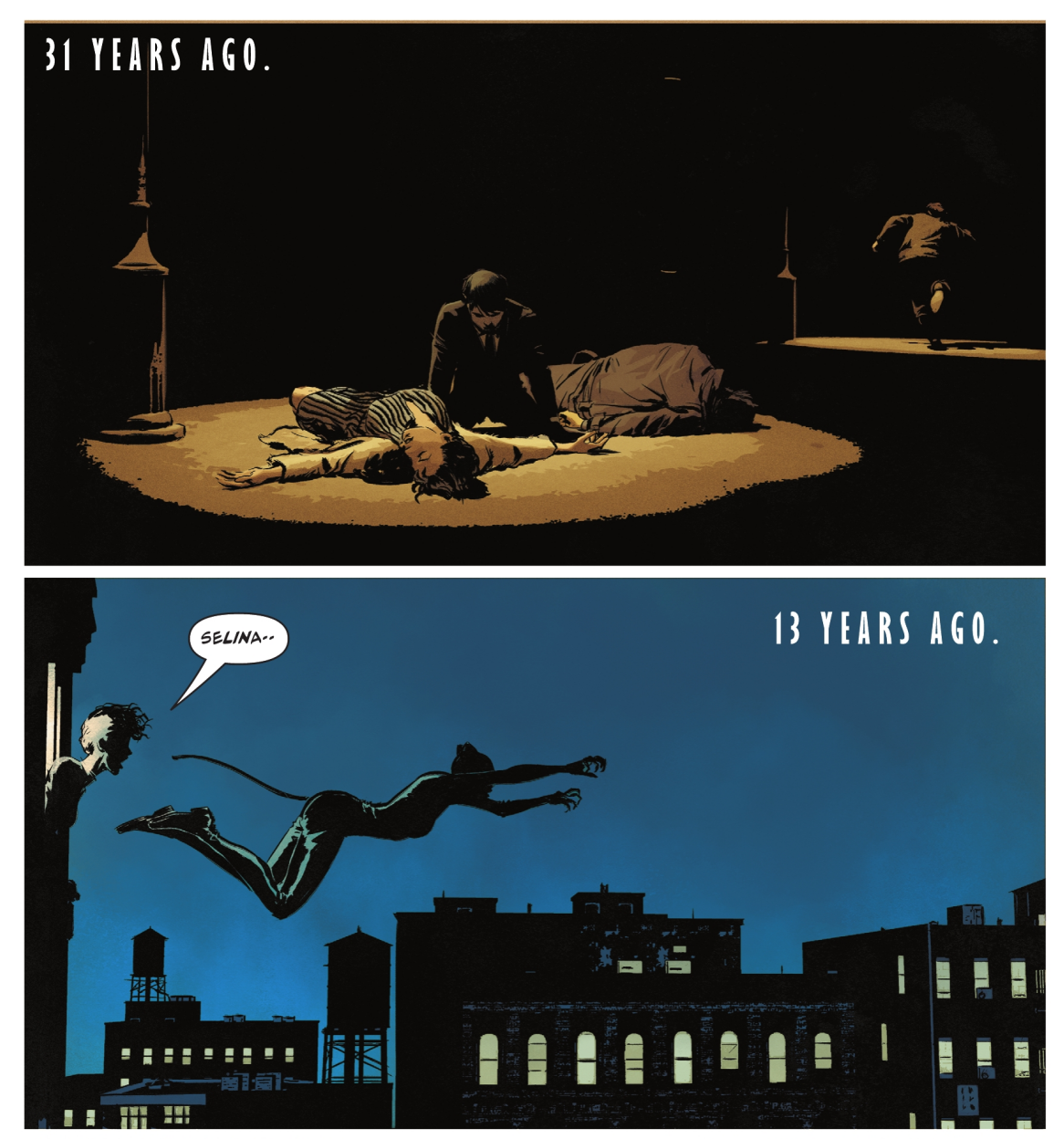
JSA #1 (2023) – “Year One” is only “13 Years Ago”.


According to The New Golden Age and JSA #1, Batman debuts a mere thirteen years ago, while Helena is born around 2023. When Helena is in elementary school (around age nine), she discovers her dad is Batman, at which time Selina forces Bruce to retire. In roughly 2040, Batman is seemingly killed. This will all be followed up in the twelve-issue JSA series, so a lot of answers could be given, and we shouldn’t take anything at face value until it ends. But with such specificity of dates and times, Johns seems to be doing… something specific.

Let’s start with Johns’ supposed future. Does it leave any place at all for Terry McGinnis? If so, all of Batman Beyond would have to go between 2032 and 2040, if indeed Batman is actually killed and stays dead in 2040. There are a lot of ways to view the future when it comes to comic books. For instance, is this future even set in canon? For that matter, are any futures? We’ll get into that in a soon-to-come follow-up blog post, but for now, I’ll leave the conversation with the fact that Johns posits a world where Helena is born “one year from now.” Are other comic book writers going to be committing to this scenario in a mere year’s time?

But let’s move on from the future and focus on what’s more important—the idea of Batman debuting thirteen years ago. It means that Bruce is born in 1982, which is not far off from what we already currently have, so that’s fine. If the Waynes are killed when Bruce is eight-years-old, that places the tragedy in 1991, which is indeed “31 years ago” as JSA #1 tells us. Johns’ implication is that Bruce trains from age eighteen until twenty-five (mirroring Frank Miller’s “Year One”). And then “13 years ago” is 2009, meaning Batman debuts at age twenty-five/twenty-six (again mirroring Frank Miller’s “Year One”).

Here’s where things get complicated and messy. For Johns’ “13 years ago” timeline to work, this means that Year One must include a lot of stuff, some of which is quite anachronistic. He must come face-to-face with the League of Assassins, during which Damian must be conceived. Damian must also be born in Year One as well. Dick would likely have to become Robin in Year One too—putting us right back into a New 52 Robin-as-internship situation. And Jonathan Kent must be conceived and born as well. Would that mean that Doomsday’s murder or Superman comes early too (as in basically immediately after he debuts)? That’s particularly messy—and likely impossible—for various reasons. Not to mention, we’ve already gotten numerous references and flashbacks to Doomsday that involve a later JLA lineup and which are based upon 1993 story material.

No matter how you spin it, a thirteen-to-fourteen-yearlong timeline requires a lot of compression, which is difficult when Johns himself restored so much continuity with Doomsday Clock (and Scott Snyder and Joshua Williamson opened up everything with “everything matters”). Where would we even compress? The early years? The middle? Surely Johns, who adores the Silver Age, isn’t suggesting that decades’ worth of that precious material get crammed into a three or four year span? The New 52 ended over five years ago. If we keep five years of story, even compressing it down a wee bit, you still aren’t left with much breathing room for eight decades of stories. And if we compress more recent stories in order to make things work, is that technically a reboot? Is it a soft reboot? Is it an official time-slide? What is it?

Let’s not forget though, not only has New Golden Age/JSA just begun, but it’s also a story heavily revolving around time-travel. With all the chronal shenanigans pertaining to the New Golden Age/JSA narrative, it’s possible that we could be dealing with alternate timelines and alternate Earths—and subsequent time-chicanery that could undo itself by arc’s end. But that remains to be seen. This is precisely why I’ve decided not to place any New Golden Age or JSA stuff on my chronology until the arc fully wraps.

Until then, and I hate to do it, I’ll delve into some conspiracy theorization. After all, I have sneaking suspicions about what’s going on, and it might have to do with fallout from the end of the Dan DiDio regime. Johns’ original intention with Doomsday Clock had been to fully reboot the DCU, going straight into Flashpoint Beyond and New Golden Age/JSA. This is precisely why he had the JSA return (with reboot) at the end of Doomsday Clock in the first place. Of course, Johns’ reboot (and DiDio’s 5G reboot) were both blocked/rejected in favor of Snyder/Williamson’s “anti-reboot” with Death Metal and Infinite Frontier. Now that Johns is back in the leadership saddle, he appears to be continuing with his original plans, despite having had a couple years of Snyder-influenced Williamson “anti-reboot” continuity. 
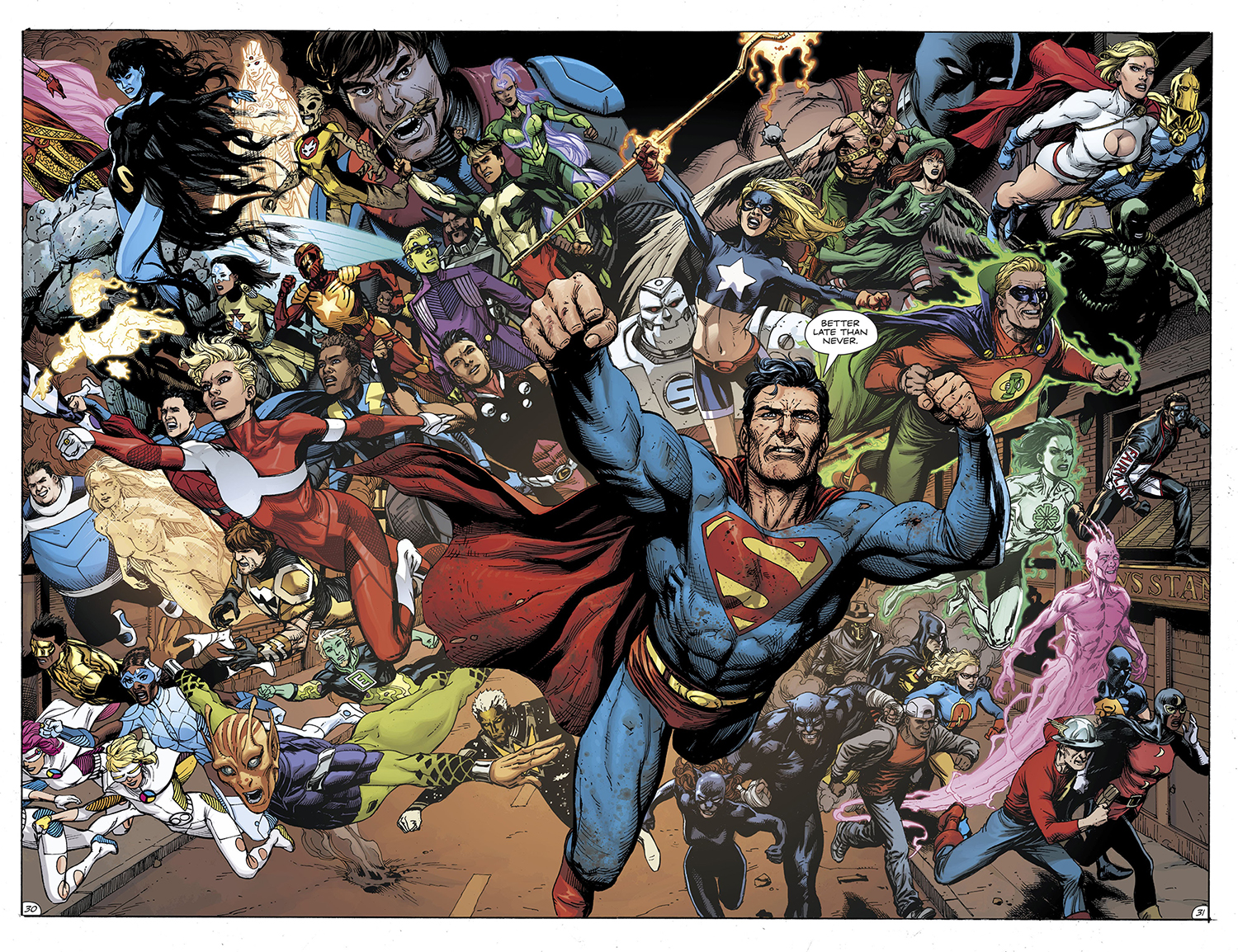
Doomsday Clock #12 (2020) – Is a reboot “better late than never”?

In any case, as I said above, I want to see the forest for the trees—step back once Johns is done with JSA to see if I can better understand his rationale. Either it’s an out-and-out reboot, a soft reboot with sliding-time (i.e. compression), or something else entirely. But again, Johns had a hard-on for a reboot a few years ago and didn’t get his way. I wouldn’t put it past him to be rebooting without fanfare, now that he’s got the power. Though, could we also see a reboot-ish type thing at the end of Dark Crisis on Infinite Earths? A new “dawn” is coming, after all. Keep an eye on that one too. Always more to come…
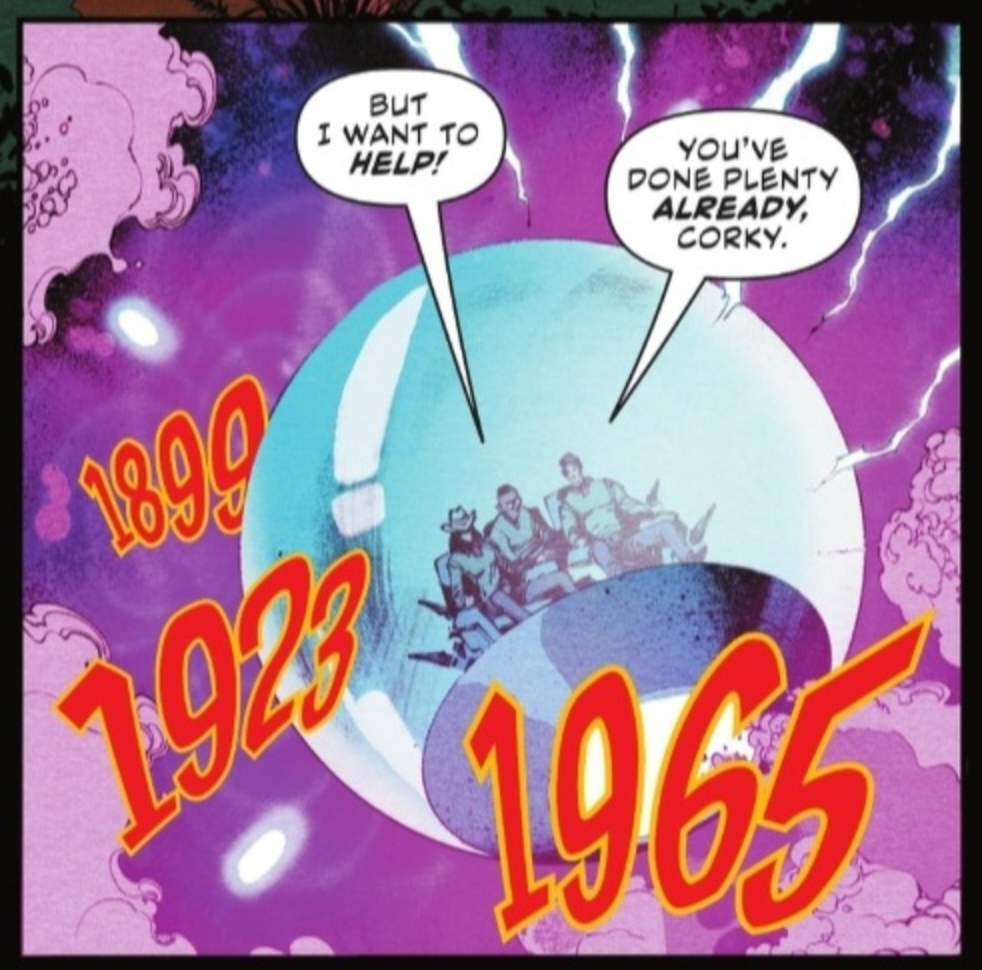
New Golden Age #1 (2023) – Blame it on Corky.


Posted in Uncategorized | 7 Comments

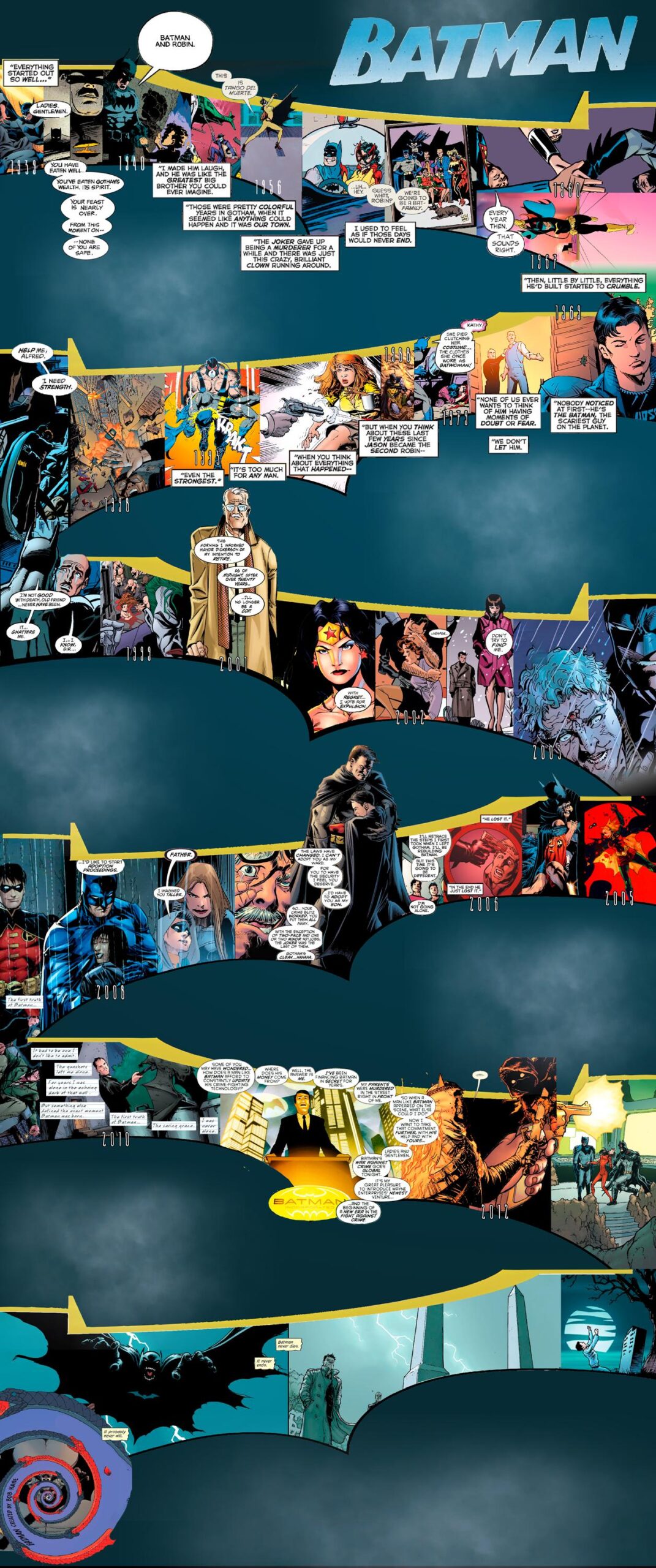
Batman Chronology Infographic

I’ve put together an infographic of Batman’s life and times, which can also be found at https://imgur.com/SzFMerS. As one should always mention (although not mentioned in the infographic), credit for Batman’s co-creation goes out to the legendary Bill Finger. Also, “A Death in the Family” and The Killing Joke have been clumped together, as have “Officer Down” and “Tower of Babel.” “Under the Hood” has been omitted but shouldn’t be overlooked.

___________________________________________________________________

Posted in Uncategorized | Leave a comment

Tom King-verse Chronology

Tom King’s continuity has taken on a life of its own in a similar way that Frank Miller’s continuity has over the past few decades. King has even stated that he now regards (or hopes others will regard) his stories as existing on their own timeline akin to how Miller’s Dark Knights Returns became the center of the author’s very own Miller-verse, which came to include all of his works, including the canonical “Year One.”

Like Miller, King started off in the realm of 100% canon—Miller began with Batman while King began with Grayson and then Batman. And like Miller, King ventured into murkier canon territory afterward—Miller wrote the Dark Knight Returns series and the All-Star Batman and Robin series while King wrote Batman/Catwoman (along with Strange Adventures, Mr. Miracle, and The Human Target). In the case of both writers, as stated, the works of each have garnered their own special timelines.

And it is with great pleasure that I present a special project—the King-verse chronology. Please check it out at the following link:

https://mega.nz/folder/jSYSBDDS#iTZ3wLeU98ka-pwi3H7VNQ

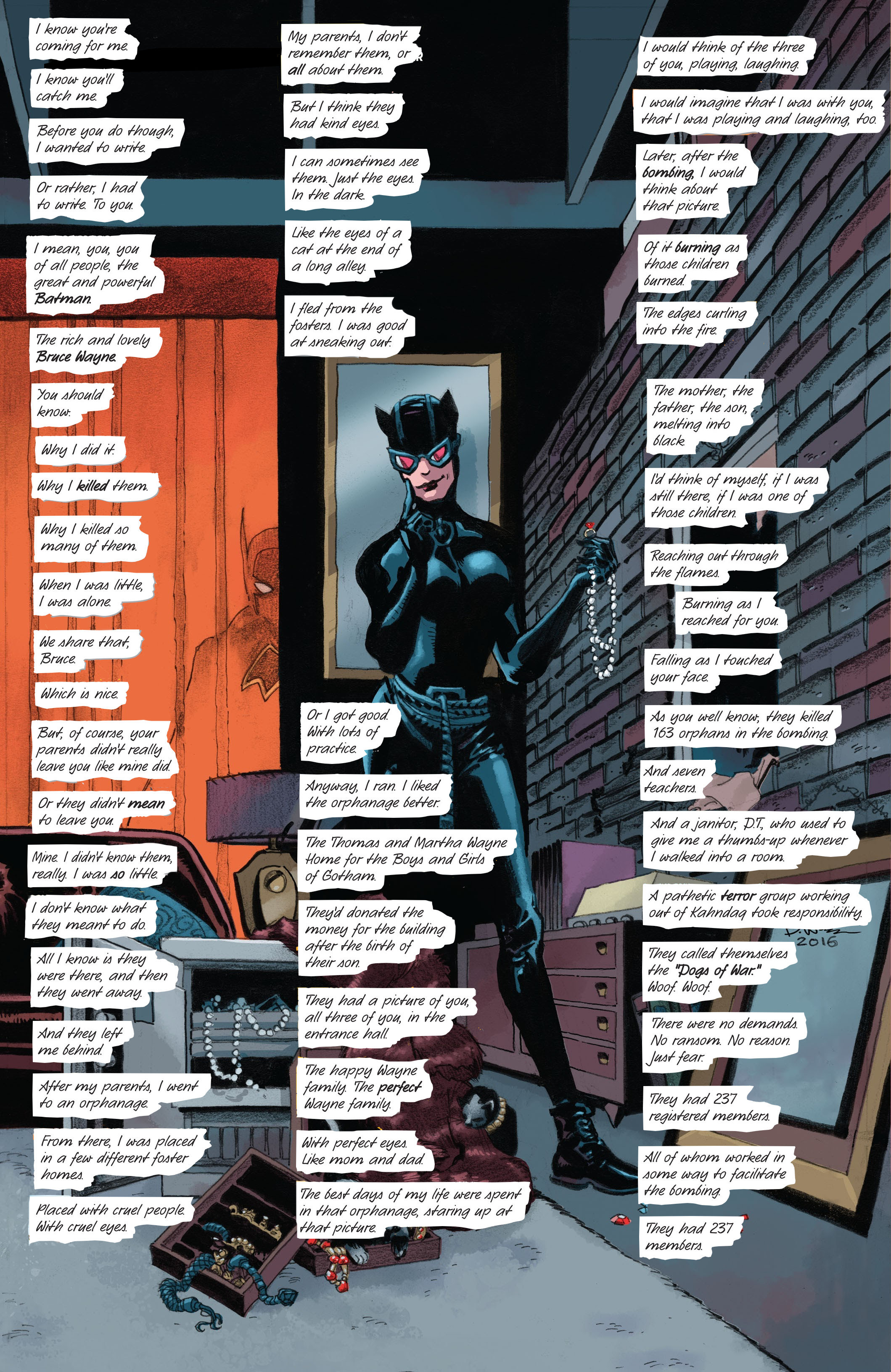
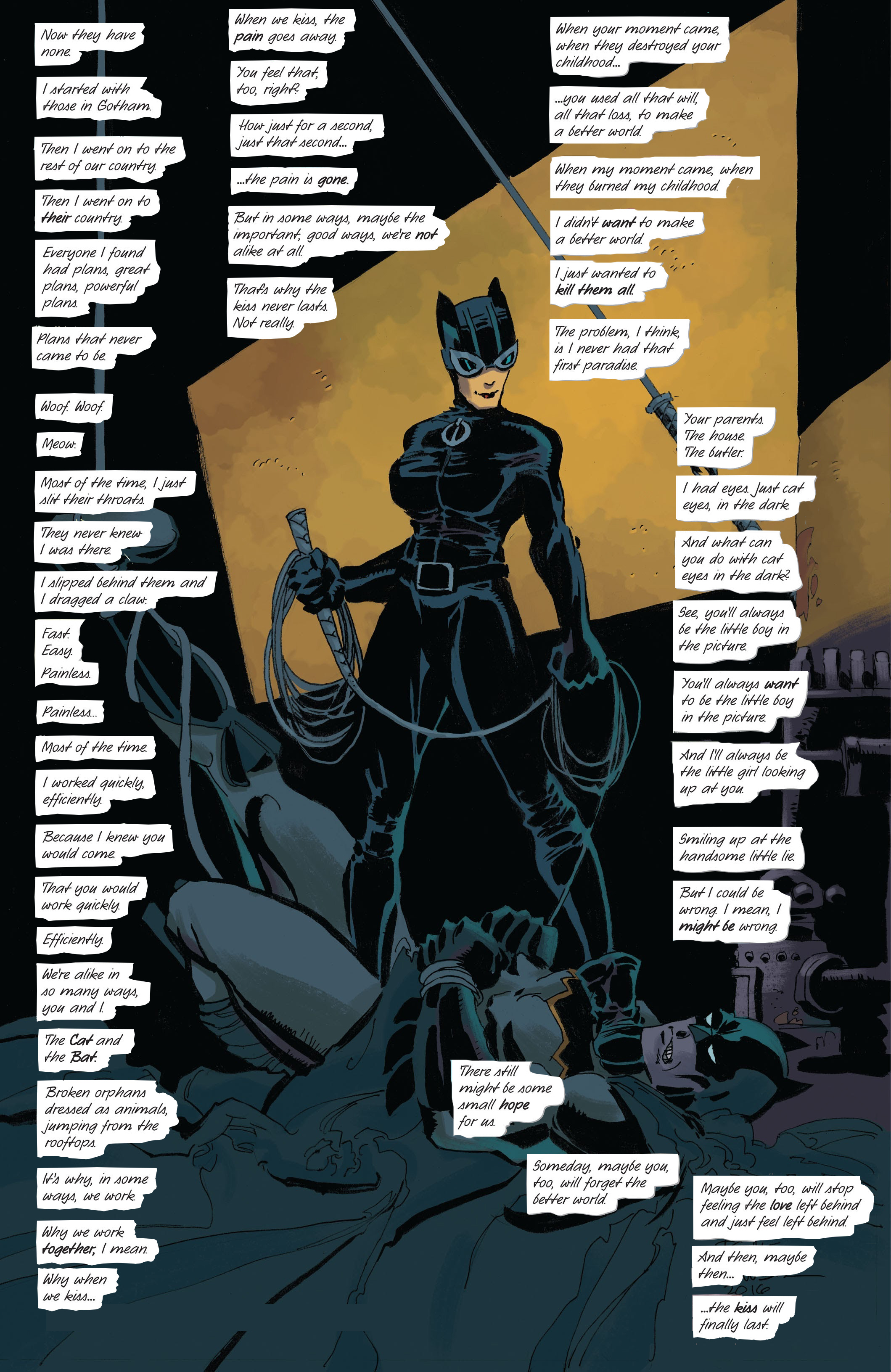
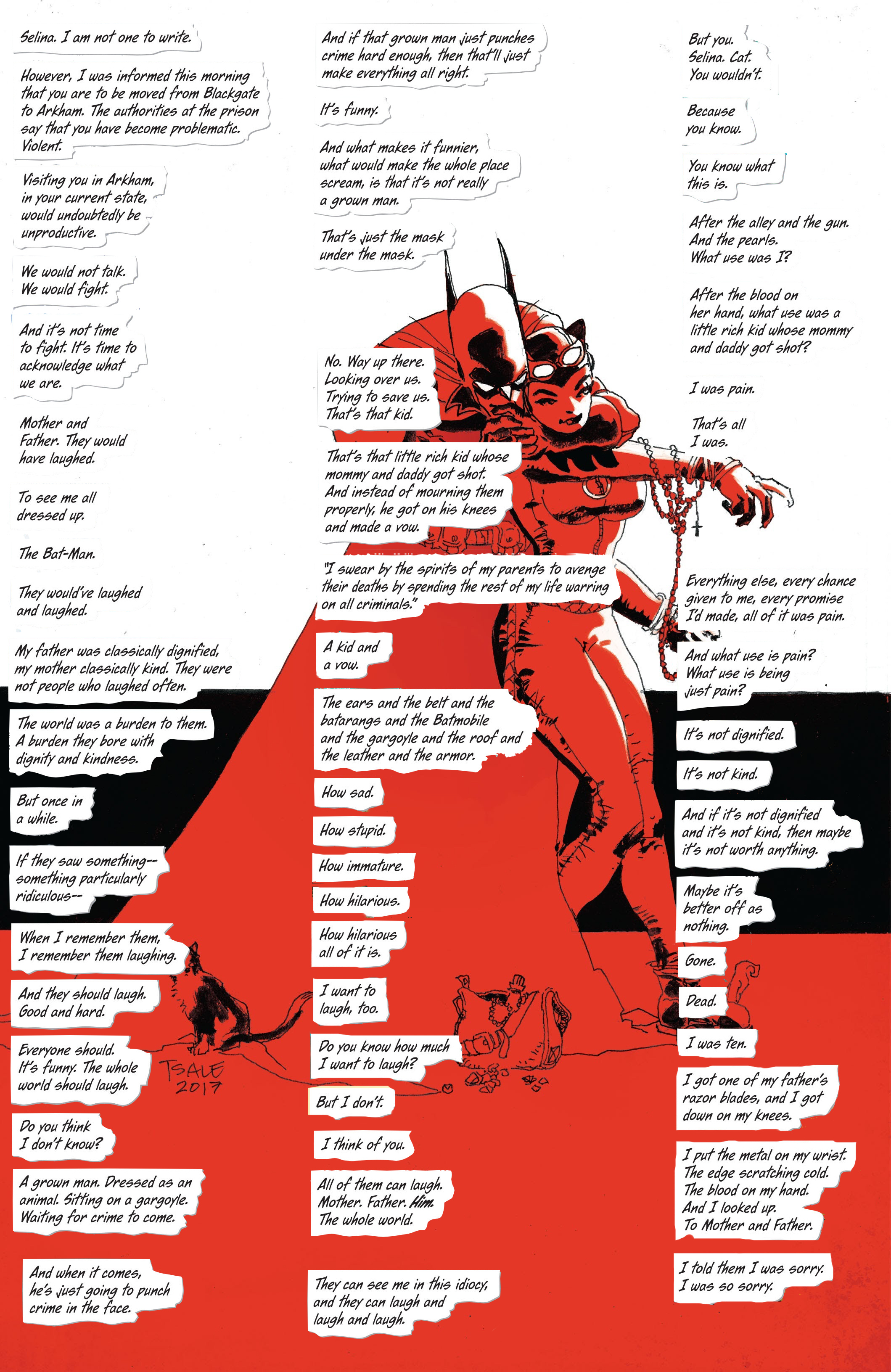
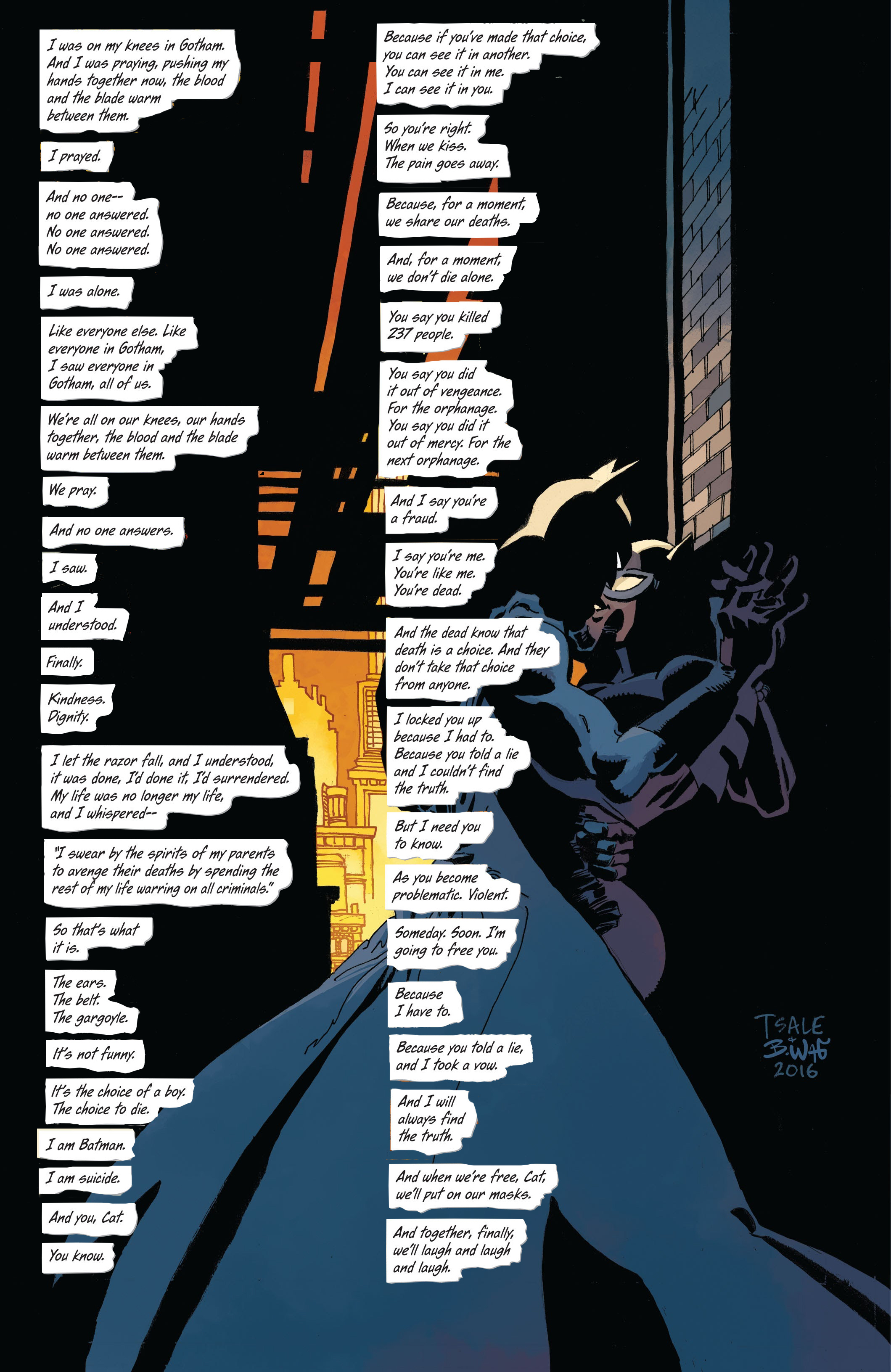
And just to wet your whistle a bit more, I’ve re-edited the letters that Batman and Catwoman sent to each other during King’s canonical Batman run. These letters, which were chopped up and scattered throughout a few issues in random order, are of key importance to King’s entire timeline. Check out these images below.

Edited by Martín Lel

_____________________________________________________________________________

Posted in Uncategorized | 12 Comments

Batman by Milo Nousiainen & Phil Buckenham

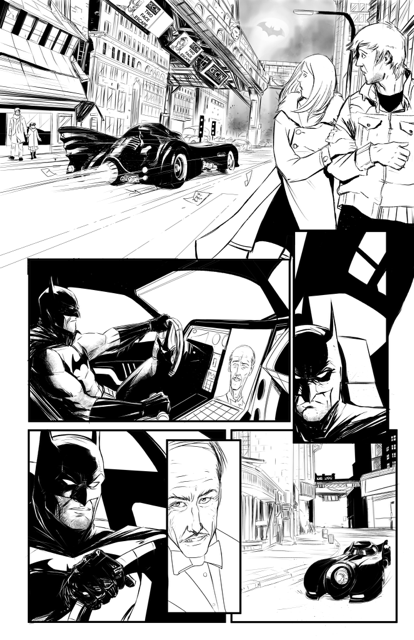
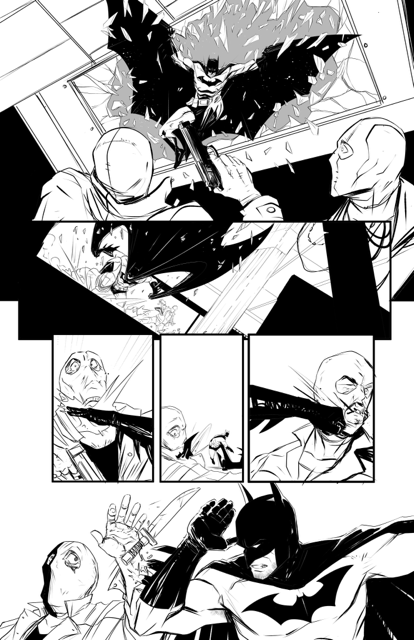
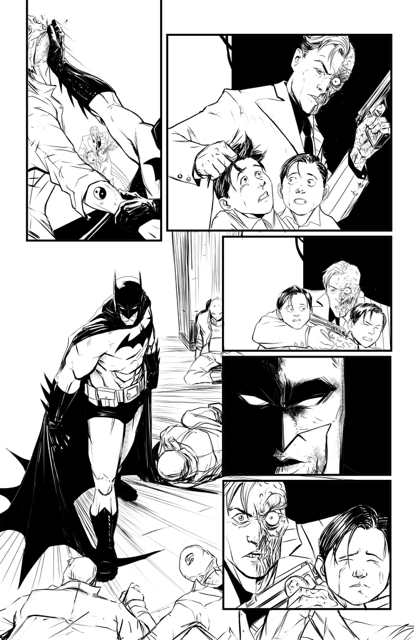
Recently, we showcased some awesome projects being done by Batman Chronology Project site contributors. And we have another one that I wanted to highlight. Writer Milo Nousiainen and artist Phil Buckenham have been creating a Batman fan comic. It’s still a work in progress, but I wanted to share a short preview of it. No letters yet, but the layouts and art are fantastic, on par if not better than a lot of what we see in the funnybooks today! Great job, Milo and Phil. And thanks for allowing me to share with the community.

Milo's comic

_________________________________________________________________

Posted in Uncategorized | Leave a comment

Tom King on Black Label Continuity

Human Target #6

The Human Target #6 by Tom King & Greg Smallwood (2022)

In a recent issue of Human Target, Tom King killed off Guy Gardner, prompting many fans to ask if the shocking death was actually in-continuity. (Up to that point, nothing in the arc would have even been questionable as to its continuity status.) King’s response was intriguing. Rather than address the death directly, King took to his Substack blog to write an interesting post about continuity in regard to DC’s Black Label line in general.

Introduced as a replacement for the defunct Vertigo line a few years ago, Black Label’s intention was to exist as a mature/Rated-R (or sometimes NC-17) version of Vertigo or Legends of the Dark Knight, which would feature a mix of in-continuity or out-of-continuity works. Of course, DC never put forth any hard concrete rules about any of this, and King, in his blog post, confirmed that DC still doesn’t have any hard concrete rules when it comes to Black Label continuity (no kidding), emphasizing that his blog entry analysis is his own interpretation of things. According to King, there are three types of Black Label titles.

The first type of Black Label consists of strictly out-of-continuity titles. While King doesn’t actually give any Black Label examples, he does use Vertigo examples—late Sandman, his own Sheriff of Babylon, the majority of Preacher, and The Invisibles. (To be clear, some of these titles have been re-released under the Black Label banner.) These types of stories do not take place in the primary DCU and are thus non-canon.

The second type of Black Label consists of “what if/what might be” books—basically alternate world, possible future, or Elseworld style stories. The Black Label example King uses here is The Dark Knight Returns (and presumably its sequels). King says that these stories, especially possible future stories, are a toss up as to whether or not they become definitive or not. He specifically says that all of the Batman/Catwoman future stuff falls into this category! (He does not elaborate whether he is solely talking about the future bits of the Batman/Catwoman Black Label series, all of which is said to be non-canon, or if he is also talking about the future stuff from his very-much-canon Batman run. However, this does make it clear that King believes that parts of stories can be canon while other parts of the very same story might not be.)

The third type of Black Label consists of titles that “are in the present, abide by all the rules of current continuity, feature big game changing moments, and try to define the characters for the current generation. […] They don’t immediately impact any of the other books on the stand, but can impact the books in the long term. They are not written in continuity, but they can become continuity.” Essentially, Kind is saying that this type is on the canonical fence until referenced by other creators. King’s examples here are The Killing Joke and his titles—Mister MiracleStrange AdventuresRorschachHuman Target, and “at least two-thirds of” Batman/Catwoman (presumably the parts that are not in the future, since he placed that third in category #2). It’s pretty messy to write an arc (King’s Batman/Catwoman arc) that falls into multiple brackets of this already vague method of categorization on top of the fact that, as a collected arc/narrative, it starts fully canon. So in this regard, King’s entire Batman/Catwoman arc falls into the categories of canon, “what if/possible future,” and borderline canon (waiting for more references). And by King’s definitions above, there can be overlap between each Black Label type. One story or arc (or even parts of one story or arc) can fall into multiple categories. I think this is a fair grasp of the Barthes-ian concept of canon in general, and it speaks to how reader and creator interpretation dictates canon more than anything else. However, it’s a bit mind-boggling that King, as the person who has more power to dictate canon than anyone else (being the creator himself), has chosen to write stories this way, almost neutering himself in regard to the power he wields. I can’t tell if it is on purpose or not.

Making matters even more confusing is that fact that King has admitted (in the John Siuntres Word Ballon podcast a few years ago) he doesn’t work well with others when it comes to continuity. This was evident with his long Batman run, and it remains evident today. For example, King wrote Dick debuting as Robin early in Year One, prior to Catwoman’s debut. Now, King is writing the ongoing Batman: Killing Time, which is rumored to retcon Robin’s debut a bit later (but still prior to “War of Jokes and Riddles,” also by King, which curiously does not feature or mention Robin). Add conspicuous and possibly contradictory takes on Dick Grayson’s early days/debut as Robin by Tom Taylor (in Nightwing), Jeff Lemire (in Robin and Batman), and Joshua Williamson (in Batman), and we’ve got ourselves a sticky wicket. If we look at King’s comments about the future of his Batman/Catwoman run, trouble brews as well. If that future, which shows an elderly Bruce succumbing to cancer, is possibly not canon, then does that mean that the new (ongoing) Batman Beyond: Neo Year series, which shows an elderly Bruce being murdered by a rogue AI, is canon instead? Maybe we are truly meant to consider all Black Label material as non-canon until otherwise stated or referenced?

Much of what King says in his post implies the current en vogue method of comic book writing for both himself and many others is a style where the author operates on the fringes of continuity, writing an impression of a character with hope (or possibly indifference) as to whether or not the story will get referenced or gain traction later. In this impressionistic style of writing, a writer can shunt aside worries about making immediate sense or having legitimate connectivity to the rest of the line. This style of long-form serialized writing makes sense if you are thinking about readers only engaging with stories via trade paperbacks and collections, but it doesn’t really jibe with the classic (and still current) way of comic book storytelling—week-to-week floppy issue tales that tell a never-ending realtime narrative. The impressionistic style also makes it incredibly difficult for the dedicated fans that read week-to-week and who try to make timelines (or even just try to make sense of ongoing stories in general), because it forces said fans to patiently adhere to a wait and see kind of response or engagement. Imagine watching a continuity-heavy TV show, but there is only tenuous connectivity between episodes and some of the episodes don’t actually happen, but you aren’t told what’s what. This might work for David Lynch or other experimental content, but it would be a disservice toward fans of most straightforward TV. Same thing can be said when it comes to fan interaction with comic books.

While it’s refreshing and eye-opening to hear a big name writer at DC talk so candidly and openly about continuity, especially some of the more confusing aspects of DC’s continuity in particular, let’s be perfectly clear: The most confusing aspects of DC’s continuity have been and continue to be created completely by the company itself. King’s explanations here are illuminating, not so much in terms of helping us better understand DC’s canon, but more so in helping us understand why it’s as confusing as it is.

________________________________________________________________

Posted in Uncategorized | 6 Comments

Who’s Who? The Demon’s Shadow

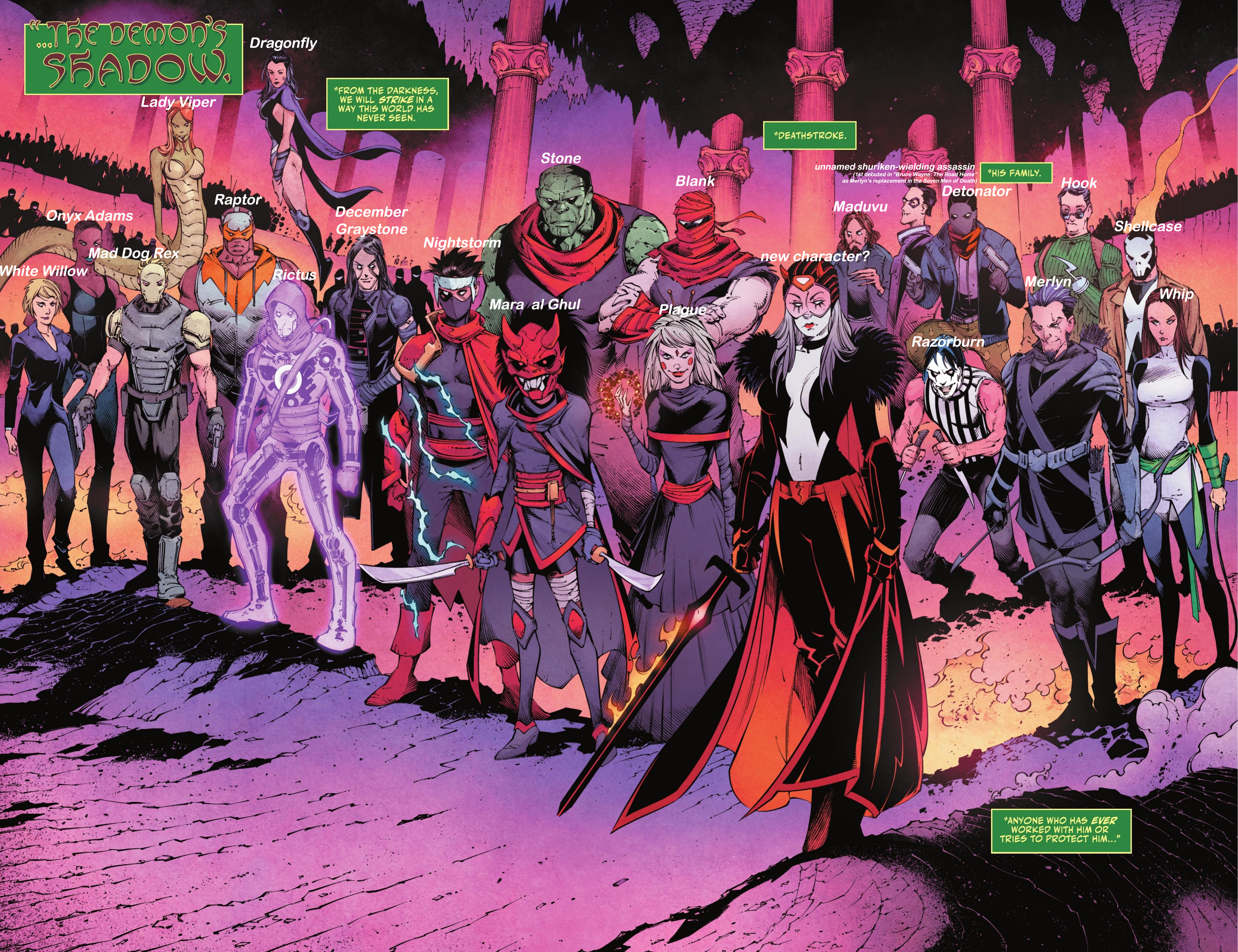
Joshua Williamson’s “Shadow War” arc has finally kicked-off with a bang. Here’s a little annotation for the Demon’s Shadow group that assembles towards the end of Shadow War: Alpha #1. The internet seems to be confused about a lot of these characters, and I’ve seen a lot of bogus info online.

Shadow War

Shadow War: Alpha #1 by Joshua Williamson, Viktor Bogdanovic, Daniel Henriques, Mike Spicer, & Troy Peteri (2022)

The first point of confusion for many starts with the Seven Men of Death, pictured toward the right of the splash. Technically, there are eight Men of Death. The original lineup featured Merlyn, Hook, Razorburn, Shellcase, Hook, Whip, and Maduvu. However, come “Bruce Wayne: The Return Home” (2010), Merlyn was no longer in the group, having been replaced by the eighth character, a domino mask-wearing guy in a trenchcoat-esque outfit, who is an expert at using shurikens. This guy, while never named in any comics, has appeared as a member of the Seven Men of Death ever since. Merlyn is obviously still affiliated with them, possibly acting as a mentor figure. The majority of internet sources, though, are content with erasing the very existence of this mysterious shuriken-wielding assassin. Any attempts I’ve made at correcting this elsewhere (*cough*, dc.fandom.com/wiki/DC Comics Database, *cough*) have resulted in strict gatekeeping in a bizarre effort to keep the erroneous status quo.

The second point of confusion for many internauts is Mad Dog, pictured toward the lefthand side of the image. Some people think this is Sportsmaster, but it ain’t. This is the version of Mad Dog, also known as Mad Dog Rex, that debuted in the New 52’s Suicide Squad. His appearance was modeled after a version of Sportsmaster from the Young Justice TV show, which is partly why folks get so confused. And yes, Sportsmaster in the late Modern Age does look a lot like Mad Dog Rex. However, the big differences are that Sportsmaster only has one shoulder pad, has slightly different armor, and is almost never pictured without some type of sports-themed weapon (not dual pistols, which is most definitely Mad Dog Rex’s thing). Not to mention, we’ve recently seen an updated Sportsmaster in the Rebirth/Infinite Frontier Era that has a very unique look, probably in an effort to differentiate him from Mad Dog! Note that Mad Dog Rex is not to be confused with Mad Dog Cain, yet another League of Assassins-related character.

The character at the forefront appears to be a new character. She gets center stage on the final page, attacking Deathstroke Inc, so I’m sure we’ll learn her name soon enough.

The rest of the characters shown in this splash have been labeled, and they can easily be Googled for more info. Hope this clears things up for everyone!

_______________________________________________________________________

Posted in Uncategorized | 10 Comments

Other Batman Chronology Projects

I thought I’d share some wonderful recent projects inspired by the Batman Chronology Project. These projects have been completed by myself, longtime regular site contributor Martín Lel, and fellow site contributor Jack James.

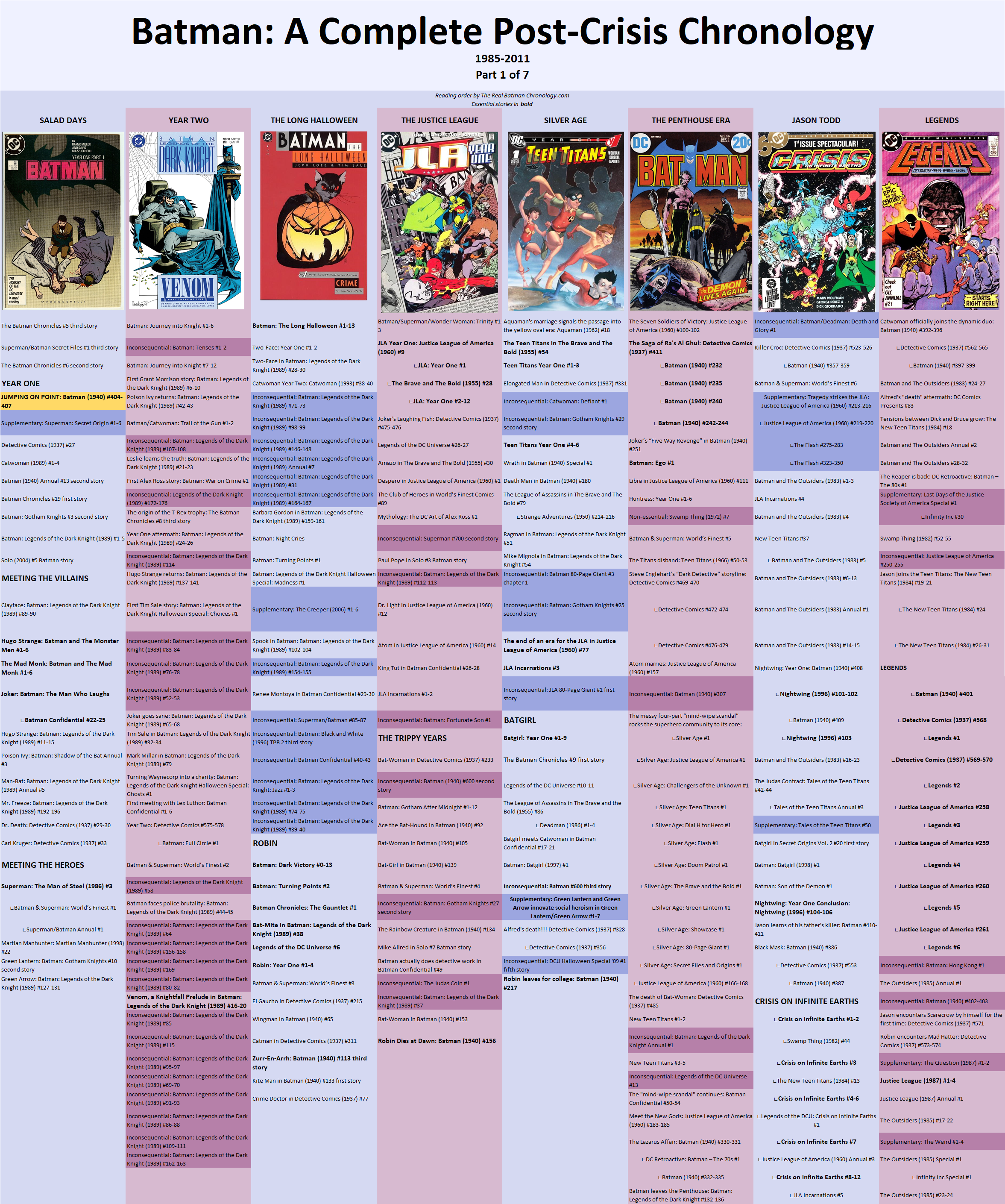
On Imgur, I’ve built an infographic, which details the post-original Crisis Modern Age timeline (1985-2011). For the full infographic, please click on the following link: https://imgur.com/gallery/B9LmB56

Martin Lel infographic

Batman: A Complete post-Crisis Chronology infographic by Martín Lel

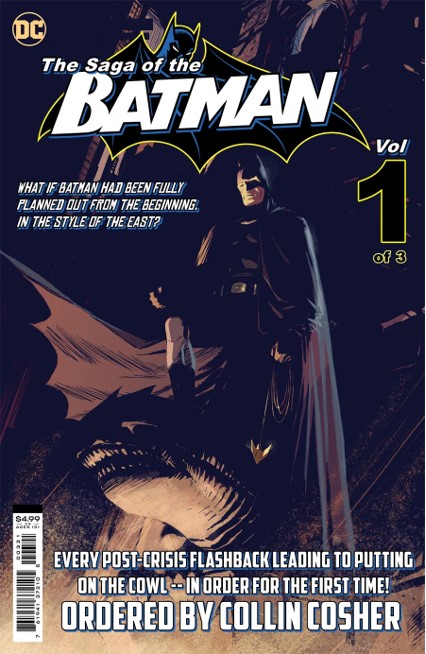
I have also assembled and cut together special digital comic book reader (cbr) files—basically a few fan-made volumes that collect all the stories set in the post-original Crisis (Modern Age) Batman’s early years in chronological order. To download the early years portion of these volumes, please click on the following Mega link: https://mega.nz/folder/ZB1mFKbJ#rJqzB57SGuh741GRPfnaNQ

Martin Lel's comic fan edits

The Saga of the Batman Vol. 1 by Martín Lel

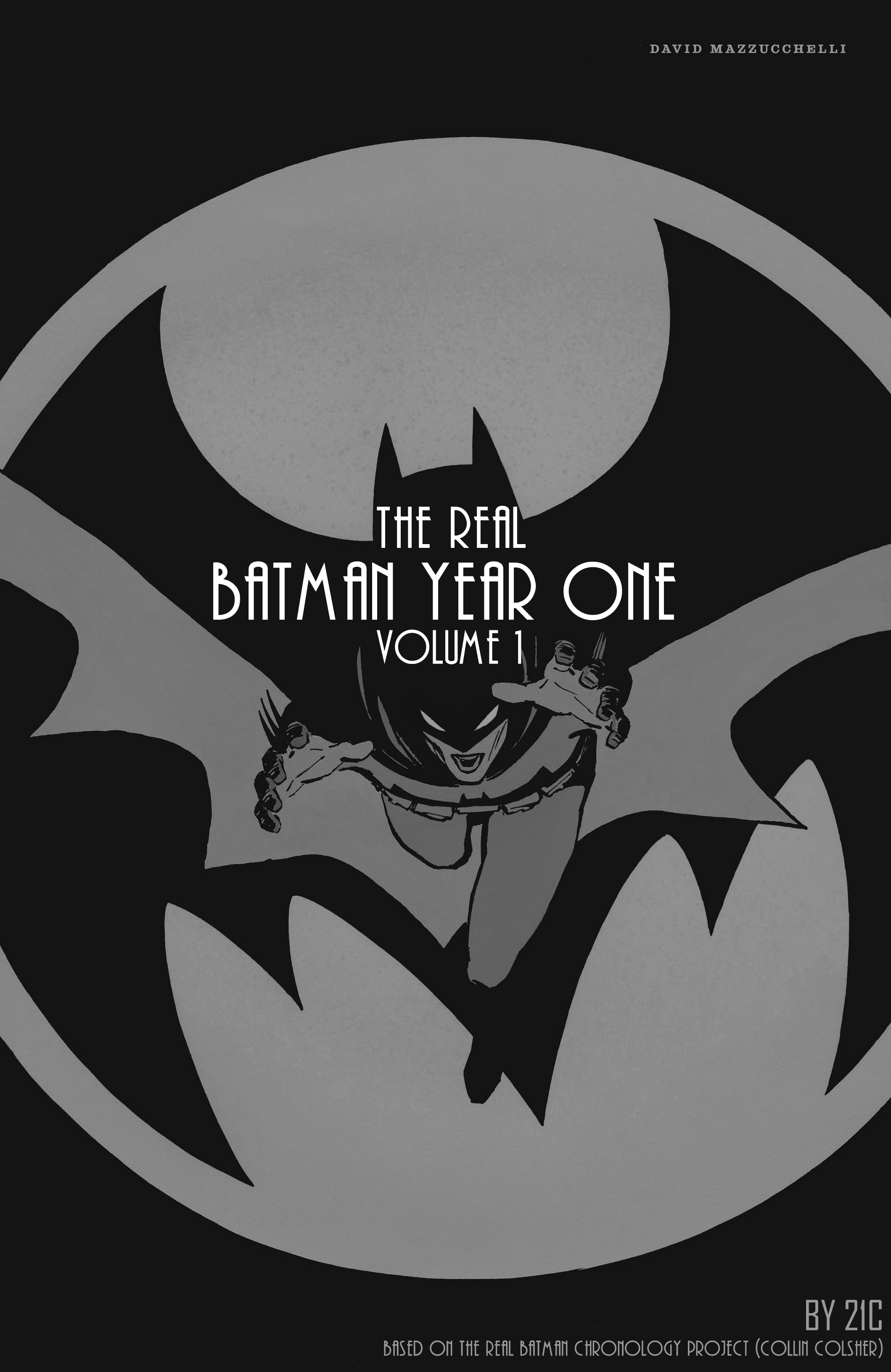
Not to be outdone, Jack has also assembled comic book volumes that collect all the stories set in the post-original Crisis (Modern Age) Batman’s first year or two in chronological order. To download his volumes, please click on the following Mega link: https://mega.nz/folder/CkR2SRxB#dwD8tCooNJGRrjQMc8SodQ

The Real Batman Year One Vol. 1 by Jack James

The Real Batman Year One Vol. 1 by Jack James

Thanks to both Collin and Jack.

_______________________________________________________________________________________

Posted in Uncategorized | 7 Comments

Things (Non-Comics) I Read in 2021

Bulgakov
In alphabetical order:

100 Selected Poems by E.E. Cummings
The American Comic Book Industry & Hollywood by Alisa Perren & Gregory Steirer
Angry Candy by Harlan Ellison
Batman and Ethics by Mark D White
The Big Sleep by Raymond Chandler
Charlie and the Chocolate Factory by Roald Dahl
Camp Concentration by Thomas Disch
The Decameron by Giovanni Boccaccio
Fanny Hill by John Cleland
Fantastic Mr. Fox by Roald Dahl
George’s Marvelous Medicine by Roald Dahl
The Good Soldier by Ford Madox Ford
The Heart of a Dog by Mikhail Bulgakov
The Immoralist by André Gide
Journey to the End of the Night by Louis-Ferdinand Céline
The Leopard by Giuseppe Di Lampedusa
The Lost World by Arthur Conan Doyle
Mother Courage by Bertold Brecht
Nadja by André Breton
Notes From Underground by Fyodor Dostoyevsky
Peter Pan by JM Barrie
The Plague by Albert Camus
The Portable Conrad (ed. by Morton D Zabel) by Joseph Conrad
The Power of Breathwork by Jennifer Patterson
The Sacred Mushroom and the Cross by John Allegro
A Scanner Darkly by Philip K Dick
Slugfest: Inside the Epic 50-Year Battle Between Marvel and DC by Reed Tucker
Superheroes and Shamanism by Timothy Bavlnka
Typhoon by Joseph Conrad
Vintage Baldwin Collection by James Baldwin
The Wanting Seed by Anthony Burgess
What is the Name of This Book? by Raymond Smullyan
The Witches by Roald Dahl
The Wonderful Wizard of Oz by L Frank Baum
Writing For Comics by Alan Moore
Wuthering Heights by Emily Brontë
The Zahir by Paolo Coehlo

Happy New Year!

______________________________________________________________

Posted in Uncategorized | Leave a comment

Current Blog, Access to Archive, & Links to Old Posts

From 2012 to 2022, disCONTINUITY was been my dedicated blog space. In 2022, it was officially retired as an archive of my old thoughts. New stuff (along with a change-log) is now contained right here within this new blog attached to the main Batman Chronology Project website.

Please note that all disCONTINIUTY links are permanently dead, although I do still have all entries in my personal archive. To access the public disCONTINIUTY archive, click on the following link:

https://web.archive.org/web/20220629123943/https://therealbatmanchronologyproject.com/blog/

Thank you to the real life superheroes at the Internet Archive / Wayback Machine for keeping a history of my thoughts and rants. Here is a list of some of my personal favorite old blog entries from disCONTINUITY from yesteryear:

Dead Links (to the Past) (2012)
(My Take on) The State of Superhero Comic Criticism (2012)
The Art of Collaborative Storytelling (2012)
Superhero Socialism (2012)
Nexus on The Longbox Project (2014)
On Batman Eternal #11 and Feminism in Superhero Comics (2014)
Comic Apocrypha: Liefeld & Platt’s Prophet (2015)
The True History of the Multiverse and the Metaphysical Laws of Grant Morrison’s Psychedelic Hyperreality (2015)
Mechanical Reproduction Beyond the Age of Mechanical Reproduction (2015)
The Nomenclature of Comic Book Eras (2015)
Harvey v Fairbairn: Color of Justice (2016)
Continuity Matters! (2016)
Superhero Socialism: The History of Anarky (2017)
A Brief Breakdown of the Bygone Batman of Earth-B (2017)
The Hole in Things: A History of Simon Hurt (2017)
Mommy Made of Nails: A History of Professor Pyg (2018)
How the Doomsday Clock Ticks: Time & Continuity at the Midpoint (2018)
The Influence of Quantum Mechanics and Borges’ Metaphysics on Superhero Comics (2019)
The Prismatic Age: Batman as a Reflection of Outdated Ideas (2019)
A List: Batman’s Sex Life (2020)
Ableist Language in Superhero Comics (2020)
Infinite Frontier: The Physics and Metaphysics of the Omniverse and Beyond (2021)

_____________________________________________________________________

Posted in Uncategorized | 3 Comments